




















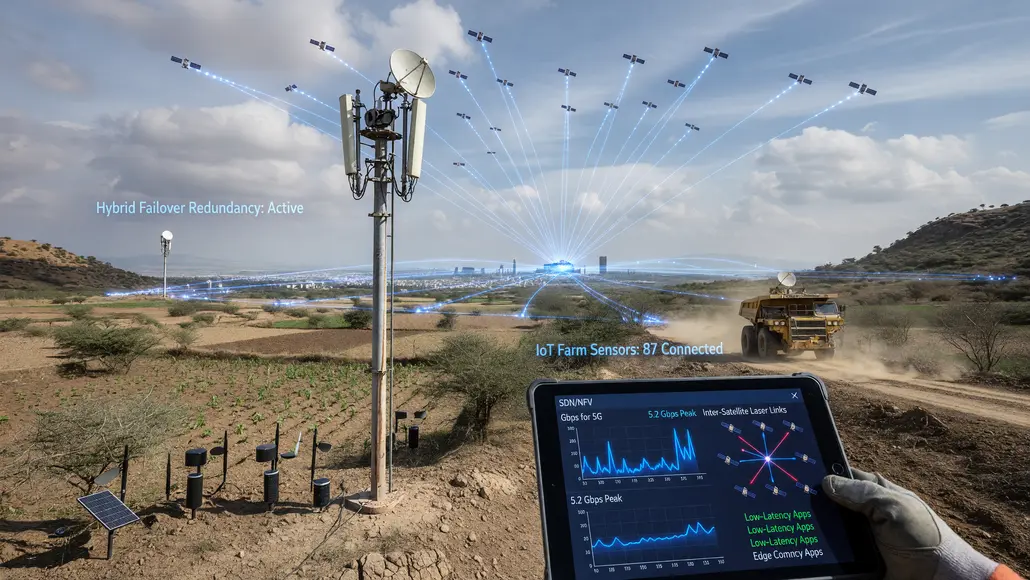

The architecture of a telecommunications network is only as strong as its backhaul—the critical link that connects remote base stations to the central core network. For decades, this has meant a massive investment in terrestrial infrastructure, from thousands of miles of fiber optic cables buried in the ground to a dense forest of microwave towers perched on hillsides. While these methods are effective in densely populated urban centers, they become a significant bottleneck when operators attempt to expand into rugged terrain or low-density rural areas. This is where the concept of satellite backhauls enabling scalable telecom operations has revolutionized the industry, offering a high-capacity, rapidly deployable alternative that can reach anywhere on the planet.
The Evolution of Backhaul Technology
Backhaul has traditionally been the most expensive and time-consuming part of network deployment. In many developing regions, the cost of laying a single kilometer of fiber can be tens of thousands of dollars, making it nearly impossible for telecom operators to justify the expense in areas with small populations. Satellite backhaul has changed this equation by providing a “plug-and-play” solution. A satellite terminal at a remote cell site can be installed in a matter of hours, immediately linking the local tower to the global network. The recent advancements in satellite backhauls enabling scalable telecom operations have focused on increasing throughput and decreasing latency, making the satellite link nearly indistinguishable from a physical cable.
The transition from 3G to 4G and now to 5G has placed immense pressure on backhaul capacity. While a 3G tower might have required only a few Megabits per second (Mbps), a modern 5G small cell can require Gigabits per second (Gbps). To meet this demand, satellite technology has moved beyond traditional wide-beam broadcasts to sophisticated multi-spot beam systems. These systems allow for the reuse of frequency spectrum across different geographical areas, dramatically increasing the total capacity of the satellite. This technological leap is the primary reason why satellite backhauls enabling scalable telecom operations are now a viable part of the 5G ecosystem.
High-Throughput Satellites (HTS) and LEO Constellations
The primary technological drivers behind the effectiveness of satellite backhaul are High-Throughput Satellites (HTS) and the emergence of Low Earth Orbit (LEO) constellations. HTS systems use multiple spot beams to reuse frequencies and provide far greater capacity than traditional wide-beam satellites. This allows for the simultaneous transmission of high-definition video, voice, and data for thousands of users. Furthermore, the shift toward LEO satellites has addressed the latency concerns that previously limited satellite backhauls enabling scalable telecom operations. By orbiting closer to the earth, these satellites reduce the “round-trip time” of data, allowing for the low-latency performance required by modern 4G and 5G applications.
The deployment of these constellations is also enabling a new concept known as “Inter-Satellite Links” (ISLs). By using lasers to transmit data directly between satellites in orbit, operators can move data across the globe without having to touch the ground until it reaches its final destination. This reduces the number of ground gateways needed and further streamlines the data transmission process. For a telecom operator, this means that satellite backhauls enabling scalable telecom operations are not only about reaching remote areas but also about providing a global, high-speed backbone that is independent of terrestrial geography.
Enhancing Network Scalability for Global Operators
Scalability is a critical metric for any modern business, and telecom operators are no exception. The ability to rapidly increase network capacity or expand into new geographic markets is a major competitive advantage. Satellite backhauls enabling scalable telecom operations provide a level of agility that terrestrial infrastructure simply cannot match. If an operator identifies a sudden surge in demand in a specific region perhaps due to a large-scale construction project or a seasonal tourism event they can deploy satellite-backed small cells to handle the load without needing to wait for months or years for fiber permits and installation. This “capacity on demand” model is essential for the dynamic nature of today’s digital economy.
This scalability is also vital for the “Greenfield” deployments of new operators. In a competitive market, being the first to provide service in a new area is key. By using satellite backhaul, a new entrant can launch a nationwide network in a fraction of the time it would take to build a traditional terrestrial grid. Once the customer base is established, the operator can then selectively replace high-traffic satellite links with fiber over time, using satellite as a powerful tool for initial market penetration and risk mitigation. This strategy proves that satellite backhauls enabling scalable telecom operations are a central part of a modern, efficient business plan.
Improving Efficiency in Data Transmission
The efficiency of data transmission is another area where satellite backhauls enabling scalable telecom operations have seen massive improvements. Advanced modulation techniques like 16APSK and 32APSK, combined with adaptive coding and modulation (ACM), allow the network to maintain the highest possible throughput even in varying weather conditions. Furthermore, modern satellite gateways are increasingly integrated with edge computing resources. This means that a significant amount of data processing, such as video transcoding or content caching, can happen at the remote site or within the satellite itself, reducing the amount of raw data that needs to be sent back to the central core.
Data compression and acceleration are also critical components. By using sophisticated algorithms to remove redundant data packets and optimize TCP/IP traffic, satellite backhauls enabling scalable telecom operations can deliver a user experience that rivals fiber. These optimizations are particularly important for applications like web browsing and cloud computing, which are sensitive to small delays in data delivery. As these technologies continue to mature, the “satellite tax” on performance is effectively being eliminated, allowing operators to offer a consistent, high-quality service across their entire footprint.
Remote Network Access and the IoT Boom
The rise of the Internet of Things (IoT) has created a massive demand for remote network access. From sensors in oil fields and mines to smart meters in rural agriculture, billions of devices need a way to send small packets of data back to a central server. Satellite backhauls enabling scalable telecom operations are the perfect solution for these distributed networks. By providing a reliable backhaul link for localized IoT gateways such as LoRaWAN or NB-IoT base stations satellites enable the collection of massive amounts of data from areas that would otherwise be invisible to the operator.
This connectivity is a vital component of the industrial digital transformation (Industry 4.0). In a large-scale mining operation, for example, satellite-backed IoT allows for the real-time tracking of autonomous haul trucks and the monitoring of site safety. This not only improves efficiency but also saves lives. The ability to provide this level of remote network access is a major revenue driver for telecom operators, as it allows them to sell complex, high-value industrial solutions rather than just simple voice and data plans. Satellite backhauls enabling scalable telecom operations are the invisible engine behind this new industrial revolution.
Enhanced Operator Service Delivery and Reliability
Reliability is the hallmark of any successful telecommunications service. When a fiber line is cut by a construction crew or a microwave link is blocked by a new building, the entire remote site goes dark. Satellite backhauls enabling scalable telecom operations provide a critical layer of redundancy. Many operators now use a “hybrid backhaul” strategy where a primary terrestrial link is backed up by a satellite connection. In the event of a terrestrial failure, the network can automatically failover to the satellite, ensuring that service remains uninterrupted.
This level of reliability is essential for mission-critical services like emergency response, banking, and government communications. For an operator, providing a “five-nines” (99.999%) uptime guarantee is only possible with a diverse and resilient backhaul strategy. Satellite technology, with its immunity to terrestrial disasters and localized infrastructure failures, is the perfect insurance policy for a modern network. By integrating satellite backhauls enabling scalable telecom operations into their core architecture, operators can deliver a level of service quality that builds long-term customer trust and loyalty.
Economic Impacts and the Future of Backhaul
The economic benefits of satellite backhaul are twofold: they reduce the initial capital expenditure (CAPEX) of network expansion and lower the long-term operational expenditure (OPEX) by streamlining network management. As the cost per bit of satellite capacity continues to fall driven by the entry of new constellation providers and the development of reusable rockets the business case for satellite backhauls enabling scalable telecom operations becomes even stronger. This trend is encouraging more telecom operators to integrate satellite technology into their core strategies rather than viewing it as a last-resort option.
Furthermore, the “managed service” model for satellite backhaul is becoming increasingly popular. Instead of purchasing and managing their own satellite equipment, operators can pay for a guaranteed level of throughput from a satellite provider. This shifts the financial burden from CAPEX to OPEX and allows the operator to focus on their core business of serving customers. This flexibility is a key part of satellite backhauls enabling scalable telecom operations, allowing for a highly responsive and efficient network that can adapt to the changing needs of its users in real-time.
The Role of Software-Defined Networking (SDN)
The future of satellite backhaul is intrinsically tied to Software-Defined Networking (SDN) and Network Functions Virtualization (NFV). These technologies allow operators to manage their satellite links with the same tools and interfaces they use for their terrestrial assets. By virtualizing the satellite modem and gateway functions, an operator can dynamically adjust the bandwidth of a satellite link based on real-time network conditions. This is the ultimate expression of satellite backhauls enabling scalable telecom operations, allowing for a network that is not only vast in its reach but also highly intelligent in its execution.
Looking ahead, we can expect to see even tighter integration between satellite providers and terrestrial telcos. The boundaries between the two industries are blurring as they work together to create a single, unified global network. In this new landscape, satellite backhaul will not be seen as a “different” type of connection, but simply as one of many tools in the operator’s toolbox for delivering a world-class connectivity experience. The era of the fragmented network is over; the era of the scalable, satellite-enabled operation has begun.