















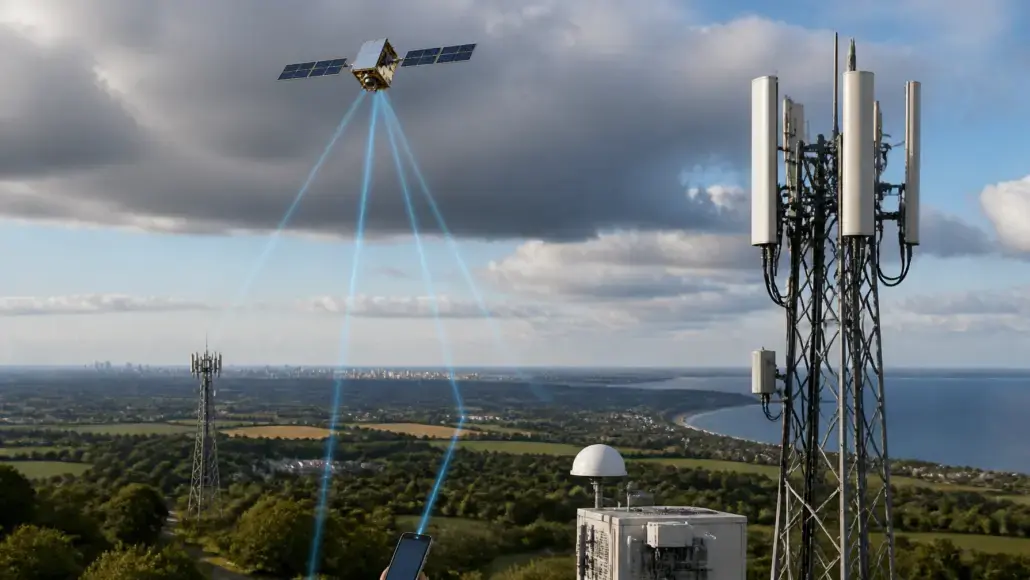

AST SpaceMobile has filed plans with the FCC for non-US direct to cell connectivity operations in the UK, naming Vodafone as its mobile network operator partner. The filing, dated 11 August 2026, details the mobile spectrum intended for service and attaches an Ofcom demonstration and trial licence. No commercial service date appears in the filing, and the Ofcom trial licence does not authorise commercial use.
The proposed arrangement is tightly controlled. Vodafone supplies licensed mobile spectrum. AST SpaceMobile provides the satellite system and commits to deactivating beams if verified harmful interference occurs. The submission was made under conditions of AST SpaceMobile’s FCC authorisation for a 248-satellite low Earth orbit system supporting direct to cell connectivity.
The proposed service uses 880.1–885.1 MHz for uplink and 925.1–930.1 MHz for downlink communications, with separate test bands at 892.1–897.1 MHz and 937.1–942.1 MHz. Direct to cell connectivity operations will remain limited to spectrum licensed exclusively to the mobile network operator partner in the country of operation, AST SpaceMobile says.
Satellite backhaul runs through a different network layer. The system uses authorised gateway earth stations, including Goonhilly Downs in the UK, with feeder downlinks at 37.5–42 GHz and feeder uplinks at 45.5–47 GHz, 47.2–50.2 GHz, and 50.4–51.4 GHz. Mobile spectrum carries the link to handsets, while gateway infrastructure connects satellite connectivity back into terrestrial networks.
Vodafone Spectrum Supports UK Direct to Cell Trial
Vodafone’s Public Wireless Network Licence, amended on 10 April 2026, defines direct to device services as wireless communications provided through a mobile satellite system enabling terrestrial users to send and receive radio signals directly to and from a space station. The licence permits direct to device service only in specified uplink and downlink blocks and requires the licensees to ensure the service does not cause harmful interference to wireless telegraphy.
Ofcom requires coverage maps showing predicted power flux density on the ground at 100-metre resolution, including unwanted transmissions up to 100 kilometres from service area boundaries. Operators must retain date-stamped historical versions of these records. A satellite used for the service cannot transmit to a UK location below a 10-degree elevation angle, and aggregate space station power at the Earth’s surface is capped at -119 dBW/MHz/m² outside the permitted blocks. The direct to device service receives no interference protection from other authorised users.
Ofcom Conditions Set Strict D2D Operating Rules
Ofcom issued Demonstration and Trial Licence 1418602/1 to Vodafone on 24 July 2026. The licence runs until 30 September 2026 and covers demonstrating satellite direct to mobile device capability across the UK. It permits a maximum ERP of 0.32 dBW on transmitting frequencies of 894.6 MHz and 939.6 MHz, each with 5 MHz channel width.
The trial licence is not renewable and can operate for a maximum of 12 months unless Ofcom revokes it or Vodafone surrenders it. Ofcom defines the licence’s status as non-commercial and unrelated to providing services or selling goods. Vodafone must check whether a proposed frequency is already in use before transmitting, operate for the minimum duration necessary, and use suppressed radiation conditions where possible.
AST SpaceMobile Links UK Tests to Wider European Campaign
AST SpaceMobile said earlier this month that network integration testing was under way across the UK, Ireland, Romania, France, the Czech Republic, Germany, Spain, and Ukraine. Vodafone, Orange, Telefónica, Deutsche Telekom, and Vodafone Ukraine are named as collaborating operators. These activities remain subject to regulatory approvals. Satellite Connect Europe, a Luxembourg-headquartered joint venture between AST SpaceMobile and Vodafone, will provide European-wide gateway infrastructure.
AST SpaceMobile commits to providing 24-hour stop-buzzer contact information for its Network Operations Centre to national licensing administrations and potentially affected operators. After notification and verification of harmful interference from direct to cell connectivity operations, satellite transmission beams covering an affected area will be deactivated. Testing authorisation does not equal production readiness. The current UK trial licence permits a non-commercial demonstration under defined radio controls until 30 September 2026.