
















International telecom connectivity depends on interconnected backbone networks, transit providers, routing systems and submarine cables that carry traffic between regions. That interdependence creates efficiency and redundancy, but it also means disruption at a critical network point can affect services beyond the infrastructure initially targeted. Tele Info Today notes that telecom transit resilience is therefore becoming a broader cybersecurity concern as operators face attacks designed to overwhelm capacity, disrupt routing or exploit dependencies across interconnected networks.
Network Attacks are Becoming Faster and Larger
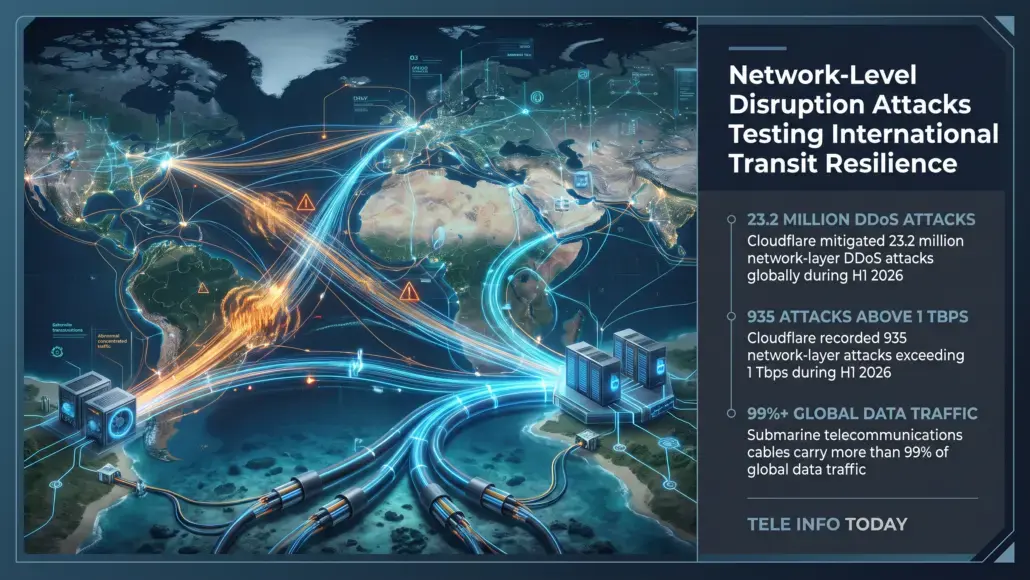
Distributed denial-of-service attacks remain a major source of network-level disruption. Cloudflare recorded 23.2 million network-layer DDoS attacks during the first half of 2026, equivalent to approximately 5,343 attacks per hour across its global network. It also mitigated 935 attacks exceeding 1 Tbps, with 805 of those occurring during the second quarter alone. These figures represent Cloudflare’s global network and are not telecom-only measurements, but they illustrate the scale and speed of the wider network threat environment.
The speed of these attacks is also significant. Cloudflare reported that 90.60% of network-layer attacks ended within 10 minutes during the first half of 2026. For network operators and transit providers, this compresses the time available to detect abnormal traffic, activate mitigation and preserve legitimate connectivity. A resilience strategy therefore needs to operate at network speed rather than depend entirely on manual intervention.
International Transit is Becoming a Critical Security Layer
The resilience challenge extends beyond individual networks because international connectivity depends on multiple interconnected physical and logical pathways. Submarine telecommunications cables carry more than 99% of global data traffic, according to the International Telecommunication Union’s 2026 submarine-cable resilience work. The same report highlights geographic concentration, physical exposure, longer repair times and dependence on limited cable systems as important resilience challenges.
These dependencies make telecom transit resilience relevant to cybersecurity even when the initial disruption does not originate inside a mobile or fixed-access network. A volumetric attack against a critical transit provider, for example, can create congestion that affects downstream networks. A routing disruption can have a different effect by sending traffic toward an unavailable or unintended path.
The result is a broader security perimeter in which operators need to consider upstream providers, peering relationships, international gateways and alternative routes alongside their own network equipment. Telecom transit resilience increasingly depends on whether these interconnected paths can absorb disruption, redirect traffic and maintain essential services while mitigation is underway.
Routing Security is Becoming Central to Transit Resilience
Network-level disruption is not limited to overwhelming traffic volumes. International connectivity can also be affected when traffic is misdirected, blocked or forced through unsuitable routes. This makes routing security an important part of telecom transit resilience, particularly for networks that depend on multiple upstream providers, peering relationships and international transit paths.
BGP Disruptions Can Redirect Traffic Across Networks
Border Gateway Protocol, or BGP, determines how traffic moves between autonomous systems across the internet. A route leak, hijack or configuration error can therefore have effects beyond the network where the original event occurs. Cloudflare’s January 2026 route-leak incident demonstrated how an unintended BGP announcement can create congestion and packet loss within a backbone environment, showing that routing failures can become wider availability problems even without a malicious attack.
The security challenge becomes greater when route manipulation is deliberate. A malicious announcement can cause traffic to follow an unintended path, creating opportunities for interception, disruption or service degradation. This makes telecom transit resilience dependent not only on having alternative routes, but also on being able to establish whether advertised routes are legitimate.
Route Validation is Becoming a Resilience Control
Route-origin validation through the Resource Public Key Infrastructure, or RPKI, provides one mechanism for checking whether an autonomous system is authorised to originate a particular network prefix. Additional approaches such as BGP Roles and Autonomous System Provider Authorization are intended to strengthen validation between network operators and reduce opportunities for route leaks.
These controls become increasingly relevant as international transit becomes more interconnected. A resilient network needs both alternative paths and confidence that those paths are legitimate. Monitoring can then identify unusual routing changes, while automated controls can limit the effect of a suspicious announcement before it spreads further across interconnected networks.
The physical layer also matters. Submarine telecommunications cables carry more than 99% of global data traffic, according to the International Telecommunication Union’s 2026 resilience report. The report identifies route diversity, infrastructure redundancy, risk monitoring and response preparedness as important measures for strengthening international connectivity. This means logical routing security and physical route diversity increasingly need to be considered together.
As operators build resilience across transit and backbone infrastructure, protection also extends to the services carried over those paths, including voice service continuity. Challenges to Telecom Networks Maintaining resilient connectivity is therefore becoming part of a wider security requirement for communications services.
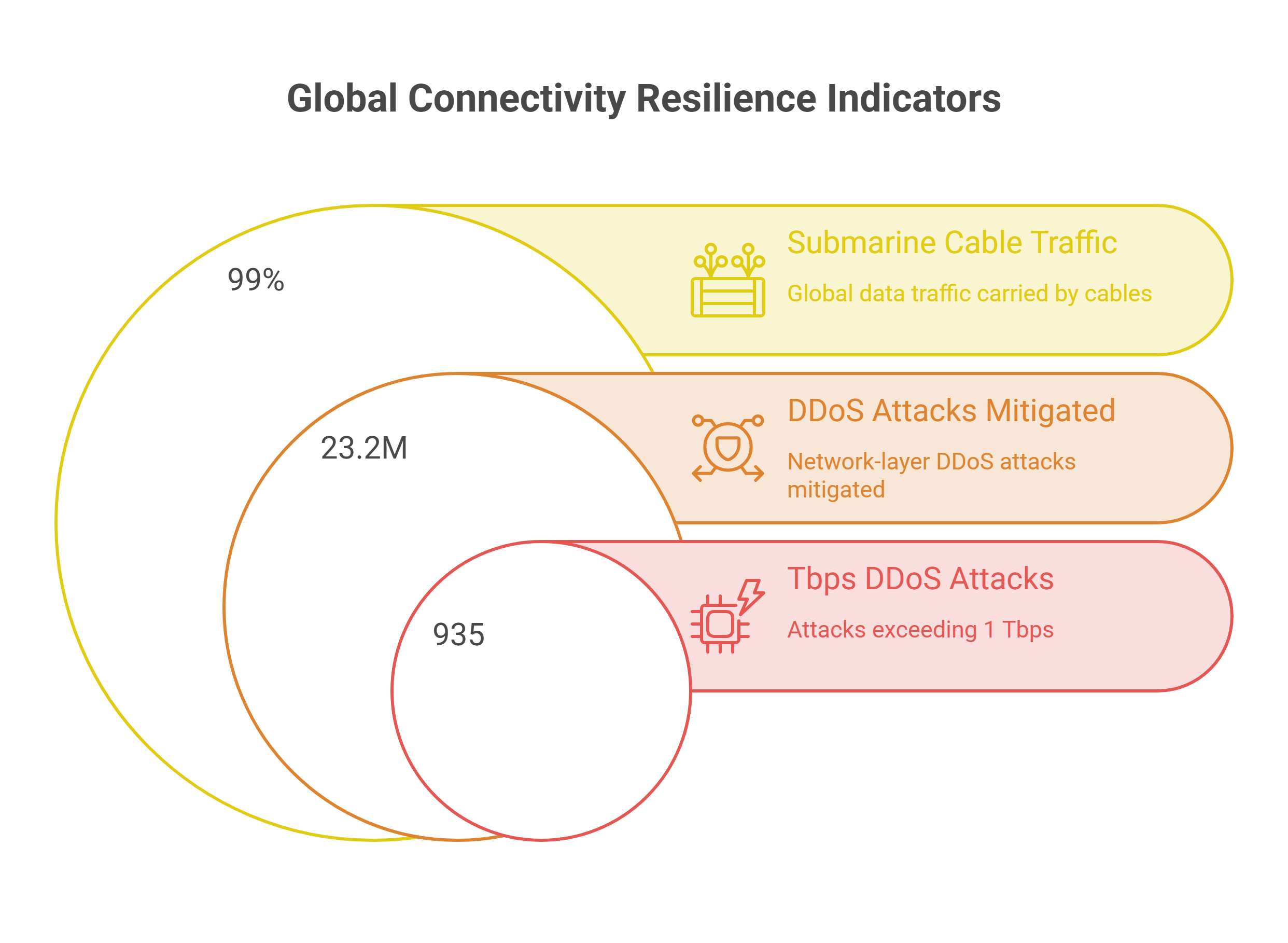
Key Takeaway: International connectivity depends on highly concentrated global infrastructure while network-level attacks continue to operate at a scale that requires routing validation, route diversity and rapid automated mitigation.
International Transit is Becoming a Broader Security Priority
Network resilience increasingly depends on the ability to maintain connectivity when traffic volumes surge, routing paths are disrupted or critical infrastructure becomes unavailable. Telecom transit resilience therefore requires more than additional network capacity. Operators also need route diversity, routing validation, continuous monitoring and automated mitigation across the wider connectivity ecosystem.
The challenge extends beyond individual networks because international traffic depends on interconnected transit providers, backbone routes, peering arrangements and physical infrastructure. Building resilience across these dependencies can reduce the likelihood that a disruption in one part of the ecosystem becomes a wider service interruption.
As network-level threats continue to evolve, Tele Info Today will continue to track how operators and infrastructure providers are strengthening international connectivity against disruption while maintaining the availability and security of critical communications services.