















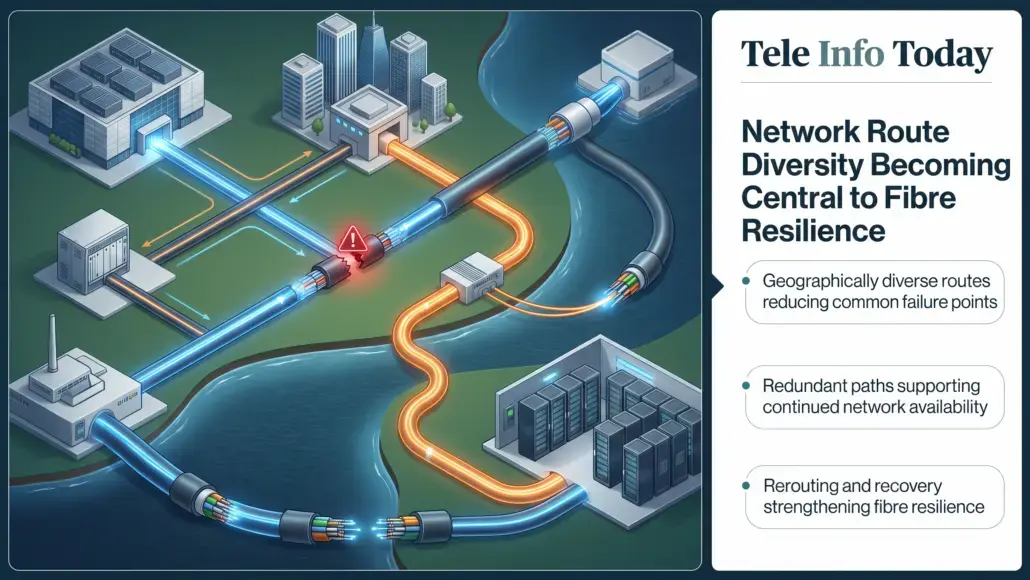

As fibre becomes more central to broadband, cloud and enterprise connectivity, the resilience of digital infrastructure is increasingly shaped by the physical routes carrying traffic between network locations. Network route diversity is becoming more important because additional connectivity does not necessarily create an independent alternative when multiple services follow the same corridor, duct, landing station or aggregation site. A single physical disruption can therefore affect several services that appear to be separately provisioned. The resilience question is consequently shifting from how much connectivity exists to how many genuinely independent paths are available across the network.
The scale of international dependence makes this issue more significant. The International Telecommunication Union estimates that submarine cables carry more than 99% of international data traffic worldwide and recorded more than 170 cable repairs globally during 2025. The commercial submarine cable network now extends beyond 1.7 million kilometres. These figures illustrate why failures affecting individual cable systems can have consequences beyond a single operator or market, particularly where international traffic is concentrated through limited physical corridors.
Geographic Diversity Extending Across the Connectivity Chain
The need for network route diversity extends across terrestrial fibre, metropolitan networks, cable landing stations and data centre connections rather than stopping at the submarine segment. Two operators may provide separate services while still relying on the same underlying infrastructure, creating a shared failure point. Resilience therefore depends on the physical independence of the routes as well as the number of providers supplying connectivity.
This principle is increasingly influencing network expansion projects. Google’s network architecture incorporates diverse and disjointed routes, while AWS uses multiple network pathways and topology reviews to identify potential points of failure. New international systems are also being designed around geographic alternatives. Google’s America India Connect includes multiple subsea paths and fibre routes, while TalayLink between Australia and Thailand is intended to establish a geographically different path from existing regional corridors. Similar diversification projects are developing across the Middle East, South Asia, Africa and Europe.
Network route diversity is therefore becoming part of network planning rather than a separate contingency measure added after deployment. As fibre carries a larger share of critical digital traffic, operators and infrastructure providers increasingly need to consider whether new routes offer genuine physical separation, how traffic can be moved when a path fails, and whether sufficient alternative capacity exists to maintain services during disruption.
Physical Separation Strengthening Fibre Network Resilience
The effectiveness of network route diversity depends on whether alternative paths are physically independent rather than simply supplied by different operators. Shared ducts, bridges, landing stations and aggregation sites can create common failure points even when customers have multiple connectivity contracts. For critical networks, operators therefore need to assess the complete physical route from the customer or data centre through the metropolitan network and backbone to the international connection. The Canadian Radio television and Telecommunications Commission’s resilience framework highlights geographically diverse physical routes as an important part of transport resilience, alongside redundant facilities and alternative network paths. This reflects a broader shift toward evaluating the actual separation of infrastructure rather than treating provider count as a proxy for redundancy.
Submarine connectivity adds another layer to this requirement. The International Telecommunication Union’s 2026 resilience recommendations identify geographic concentration and dependence on a small number of cable systems as structural risks. New routes are consequently being planned not only to increase capacity but also to diversify existing corridors. Google’s America India Connect includes multiple subsea paths and strategic fibre routes, while TalayLink between Australia and Thailand is designed to establish an alternative geographic path through the region. Similar projects across the Middle East, Africa and other markets are expanding the number of physically distinct international connections.
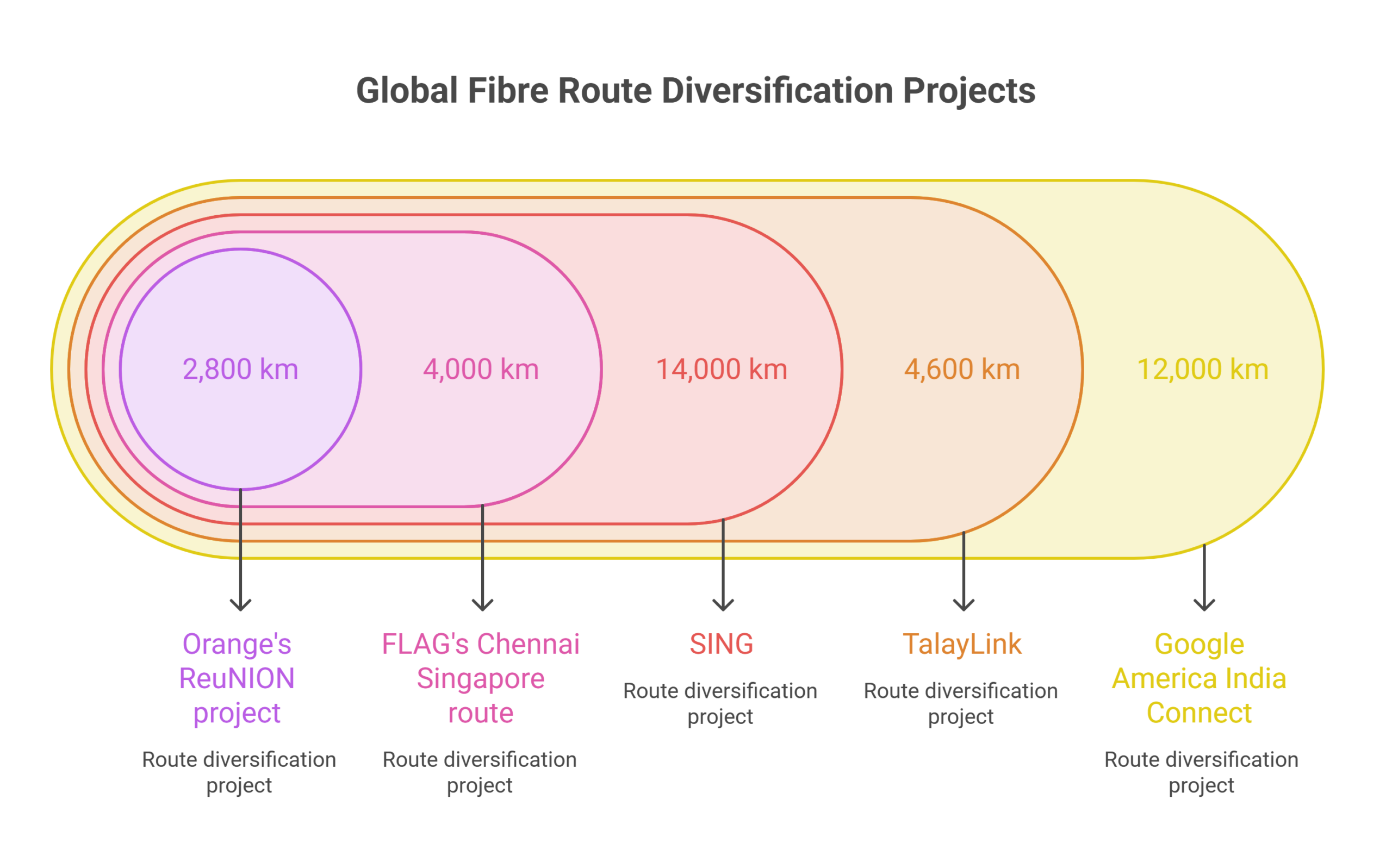
New fibre routes are increasingly being designed to add geographic alternatives, helping reduce dependence on concentrated physical corridors.
Rerouting and Recovery Extending Resilience Beyond Infrastructure
Building an independent route is only one part of resilience. Networks also need sufficient spare capacity and traffic-management systems to move services when a primary path fails. Google describes using diverse network paths together with automated rerouting to shift traffic around disruptions, while AWS maintains multiple pathways and reviews network topology to identify potential points of failure. These approaches show that network route diversity works most effectively when physical alternatives are combined with routing and operational mechanisms that can use them during an outage.
Recovery capacity is equally important. The ITU has identified repair readiness, vessel availability and regulatory coordination as important factors in restoring damaged submarine infrastructure. Network route diversity can reduce the immediate impact of a failure by providing alternative paths, but it does not remove the need to repair the damaged asset. Operators therefore need to consider route independence, spare capacity, monitoring and restoration procedures together when designing resilient fibre infrastructure.
Fibre Resilience Moving Toward More Diverse Network Architecture
As fibre becomes increasingly important to broadband, cloud and enterprise connectivity, network route diversity is becoming a more fundamental part of resilient network design. Physical separation across terrestrial routes, metropolitan paths, landing stations and international cable systems can reduce dependence on individual failure points, while spare capacity and automated rerouting can help maintain services during disruption. Resilience also depends on recovery, making repair readiness and restoration processes important alongside infrastructure redundancy.
The growing emphasis on route diversity does not eliminate the risk of outages, but it can reduce the likelihood that a single physical failure affects multiple services at the same time. This makes resilience an architectural consideration that needs to be incorporated as networks are planned, upgraded and expanded. It also increases the importance of continuous network monitoring, as operators seek greater visibility into the condition and performance of fibre infrastructure.