


















The fourth industrial revolution is no longer a future-looking concept; it is the living reality of the modern global economy. At the center of this revolution is a profound shift in how we perceive the relationship between machinery and intelligence. Historically, industrial automation was synonymous with “hard-coded” repetition machines that could perform a single task perfectly for thousands of hours but were utterly incapable of adapting to even a minor change in their environment. The emergence of AI driven automation industry operations has shattered this limitation. We are now entering an era where factory floors and supply chains are populated by systems that do not just follow instructions but possess the cognitive capacity to learn, iterate, and optimize their own workflows. This transition represents the most significant leap in industrial productivity since the introduction of the assembly line, providing the foundation for a truly autonomous global production network.
The Cognitive Shift in Smart Manufacturing and Robotics Integration
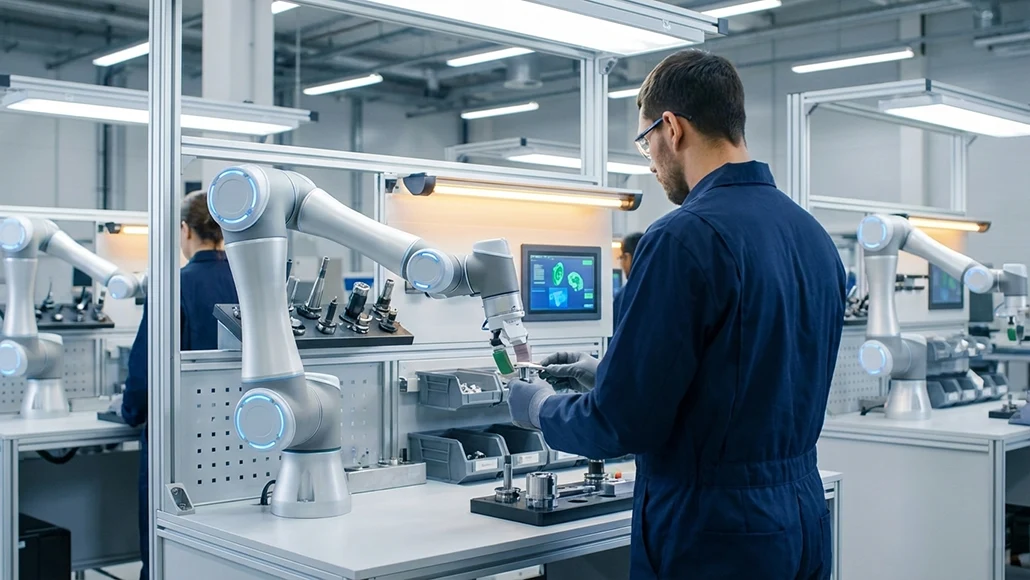
The primary differentiator in the modern industrial landscape is the move toward cognitive manufacturing. Traditional robotics integration focused on precision and speed, but modern systems prioritize perception and decision-making. Through the use of advanced computer vision and sensor fusion, robots are now capable of operating in unstructured environments. They can identify irregular objects, navigate around human coworkers safely, and correct their own errors without stopping the production line. This adaptability is the hallmark of AI driven automation industry operations, allowing factories to switch between different product variants with minimal downtime. The result is a “mass customization” model where the efficiency of large-scale manufacturing is combined with the flexibility of a bespoke workshop.
Predictive Maintenance as the Engine of Operational Stability
One of the most immediate and impactful applications of intelligence in industry is the transition to predictive maintenance. In the legacy model, machinery was either run until it failed or maintained on a rigid, often unnecessary schedule. Both approaches are inherently wasteful. By applying AI driven automation industry operations to telemetry data from industrial assets, companies can now identify the “signatures” of impending mechanical failure weeks before they occur. Algorithms analyze heat patterns, vibration frequencies, and energy consumption to detect microscopic anomalies that a human inspector would never notice. This foresight allows for “just-in-time” repairs, ensuring that the production line only stops when it is most convenient for the business, thereby virtually eliminating the catastrophic costs of unplanned downtime.
Orchestrating Enterprise Automation through Digital Twins
To manage the complexity of a modern smart factory, engineers are increasingly turning to the concept of the “Digital Twin.” This is a high-fidelity virtual replica of the entire production ecosystem, kept in sync by real-time data. Within this virtual environment, AI driven automation industry operations can run millions of simulations to find the optimal configuration for any given task. If a manager wants to increase the throughput of a specific line, they can first test the change in the digital twin, observing how it affects upstream supply and downstream logistics. This risk-free experimentation allows for a level of Industry 4.0 innovation that was previously impossible, transforming the factory from a static asset into a dynamic, software-defined entity that evolves alongside the needs of the market.
The Human-Centric Side of Industrial Automation AI
A common anxiety surrounding the rise of autonomous systems is the potential displacement of the human workforce. However, the reality of AI driven automation industry operations is often one of augmentation rather than replacement. By taking over the “three Ds” tasks that are dull, dirty, or dangerous AI allows human workers to move into roles that require creative problem-solving and emotional intelligence. In a modern plant, a technician might spend their day working alongside a “cobot” (collaborative robot), training it to perform a new task or analyzing the data generated by the plant’s AI. This synergy between human intuition and machine precision is what drives the highest levels of operational excellence, creating a safer and more engaging environment for the workforce.
Overcoming the Challenges of Scalable Enterprise Automation
While the benefits are clear, the path to fully integrated AI driven automation industry operations is not without its hurdles. One of the primary obstacles is “data silos” situations where different machines or departments use incompatible data formats. For AI to be effective, it requires a unified data fabric that spans the entire organization. This necessitates a robust digital transformation strategy that prioritizes interoperability and standardized communication protocols like OPC-UA or MQTT. Furthermore, the massive amount of data generated at the “edge” of the network requires high-performance computing localized on the factory floor to ensure that decisions can be made in milliseconds, without the delay of sending data to a distant cloud server.
The Role of AI in Sustainable and Circular Manufacturing
As the global community faces the urgent challenge of climate change, the role of intelligence in driving sustainable manufacturing cannot be overstated. AI driven automation industry operations are a powerful tool for reducing the environmental footprint of industry. By optimizing energy consumption and minimizing material waste through precision control, AI ensures that every watt of power and every gram of raw material is utilized to its full potential. Furthermore, AI is the key to the “circular economy,” where products are designed for easy disassembly and recycling. Intelligent systems can identify and sort materials at the end of their life cycle, ensuring that valuable components are returned to the production loop rather than ending up in a landfill.
The Future Horizon: Autonomous Supply Chains and Beyond
Looking toward the end of the decade, the scope of AI driven automation industry operations will expand far beyond the walls of the factory. We are moving toward a world of “autonomous supply chains,” where AI systems manage everything from the procurement of raw materials to the final delivery to the consumer. In this future state, the supply chain is a self-correcting organism that can anticipate a port strike on one continent and automatically reroute shipments through a different channel, all while optimizing for cost and carbon emissions. This level of systemic intelligence will provide the global economy with a level of resilience and efficiency that is currently unimaginable, cementing AI as the foundational technology of the modern industrial age.
Ethical Governance and the Security of Industrial AI
As we cede more operational control to autonomous systems, the importance of cybersecurity and ethical governance grows exponentially. An AI-driven factory is a high-value target for state-sponsored actors and cybercriminals. Therefore, AI driven automation industry operations must be protected by “security by design,” utilizing AI-driven threat detection to monitor for any signs of tampering or sabotage. Ethically, companies must ensure that their algorithms are transparent and that there is always a “human-in-the-loop” for critical decisions. The future of industry depends on the trust of both the workforce and the public, and that trust is built on a foundation of safety, transparency, and accountability.
Key Takeaways:
- AI driven automation is transforming industry from a model of rigid, pre-programmed tasks to one of flexible, cognitive workflows that learn and optimize in real-time.
- Predictive maintenance and digital twins are the primary drivers of operational stability, allowing for the elimination of unplanned downtime and risk-free experimentation.
- The future of manufacturing lies in the synergy between human creativity and machine precision, supported by a commitment to sustainability and the ethical governance of autonomous systems.