





















The global economy is currently undergoing a fundamental reorganization around the capabilities of artificial intelligence. We have moved beyond the phase where AI was an experimental tool used by a handful of silicon valley giants; it is now the primary engine of productivity across every sector, from healthcare and finance to logistics and entertainment. However, the software of AI is only as powerful as the hardware that supports it. The emergence of enterprise IT infrastructure AI economy represents a critical shift in the physical and logical foundations of the corporate world. To survive and thrive in this new landscape, businesses must abandon the general-purpose computing models of the past and embrace a new architecture defined by massive parallelism, ultra-high-speed data fabrics, and a seamless integration between the on-premise data center and the public cloud.
The Shift Toward High Performance Computing and Accelerated Architectures
For decades, the workhorse of the enterprise was the central processing unit (CPU) a versatile chip designed to handle a wide variety of tasks. However, the mathematical operations required for deep learning are vastly different from those of traditional business software. AI requires the simultaneous processing of millions of simple calculations, a task for which the GPU (Graphics Processing Unit) and specialized NPUs (Neural Processing Units) are far better suited. Building an enterprise IT infrastructure AI economy necessitates a move toward these accelerated architectures. By integrating high performance computing (HPC) clusters into the corporate environment, organizations can reduce the time required to train a new machine learning model from weeks to hours, providing a critical advantage in a market where speed to insight is everything.
Data Center Modernization and the Challenges of Power and Cooling
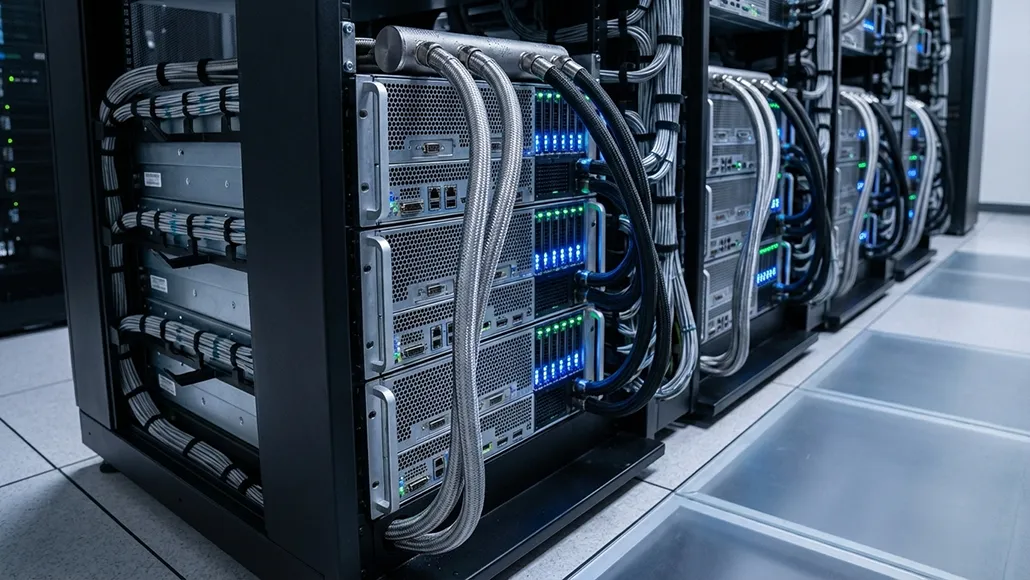
The intense processing power required for AI workloads has a direct physical impact on the data center. A rack of AI-specialized servers can consume five to ten times as much power as a traditional server rack, generating a staggering amount of heat. This reality is driving a wave of data center modernization. Traditional air-cooling systems are often unable to cope with the heat density of modern AI chips, leading many organizations to explore liquid cooling solutions where a coolant is piped directly to the processors to carry heat away more efficiently. Furthermore, the massive power requirements of the enterprise IT infrastructure AI economy are forcing companies to rethink their energy strategies, with many investing in on-site renewable energy and advanced battery storage to ensure the stability and sustainability of their operations.
Scalable IT Systems and the Rise of the Data Fabric
AI is a data-hungry technology. To train an effective model, an enterprise must be able to ingest and process petabytes of information from across the entire organization. This is only possible if the enterprise IT infrastructure AI economy includes a robust and scalable data fabric. A data fabric is a software-defined layer that provides a unified view of all corporate data, regardless of where it is stored in an on-premise database, a cloud storage bucket, or a remote edge device. This connectivity ensures that the AI engines have constant access to the freshest information, allowing for real-time inference and more accurate predictions. Building these scalable IT systems requires a move away from “data silos” toward a more fluid, interconnected architecture where data moves as easily as electrical current.
Cloud AI Platforms and the Hybrid Strategy
While many organizations are modernizing their own data centers, the public cloud remains an essential component of the enterprise IT infrastructure AI economy. Cloud AI platforms offer an “on-demand” model for high-performance computing, allowing businesses to scale their AI workloads up or down without the need for massive capital investment in hardware. However, for many enterprises, a pure-cloud strategy is not viable due to concerns over data privacy, latency, and regulatory compliance. The solution is a “hybrid AI” model, where sensitive data and mission-critical models are handled on-premise, while less sensitive training tasks and large-scale burst capacity are offloaded to the cloud. This hybrid approach provides the perfect balance of control and flexibility, allowing the organization to adapt its infrastructure to the specific needs of each project.
Implementing a Cohesive Digital Enterprise Strategy
Success in the AI economy is not just a matter of buying the latest chips; it requires a comprehensive digital enterprise strategy that aligns the IT infrastructure with the long-term goals of the business. This strategy must address the skills gap within the organization, as managing an AI-centric infrastructure requires a different set of expertise than traditional IT. Engineers must understand the nuances of distributed computing, high-speed networking (such as InfiniBand or 400G Ethernet), and the specialized software stacks like CUDA or PyTorch that power modern AI. A successful strategy focuses on building an “infrastructure for innovation,” where the technology serves as a frictionless platform that allows the business’s data scientists and developers to bring new ideas to market as quickly as possible.
The Role of Edge AI in a Distributed Economy
As we move toward a world of billions of connected devices, the enterprise IT infrastructure AI economy is expanding to the extreme edge of the network. “Edge AI” involves placing small, efficient AI chips directly into devices like industrial sensors, medical equipment, and delivery drones. This allows for instant decision-making at the point of data collection, without the need to send data back to a central server. For an enterprise, this means that a production line can automatically adjust itself to a change in material quality, or a security camera can identify a threat in milliseconds. Building a distributed infrastructure that can manage and update these edge devices is the next great challenge for IT leaders, requiring a new generation of management tools that can operate across a massive, fragmented landscape.
The Economics of AI Infrastructure and ROI
Investing in the enterprise IT infrastructure AI economy is a high-stakes endeavor. The cost of modern AI hardware and the energy to run it can be staggering. Therefore, it is essential for organizations to have a clear understanding of the return on investment (ROI). This involves moving beyond simple metrics like “uptime” and toward more business-centric outcomes, such as “time to model accuracy” or “impact on customer churn.” By treating the IT infrastructure as a direct contributor to the company’s bottom line, leaders can make more informed decisions about where to invest and how to optimize their resources. The goal is to create an infrastructure that is not just powerful, but also efficient and sustainable, providing a long-term competitive advantage in a world defined by algorithmic competition.
Securing the AI Foundation: Data Integrity and Model Safety
Finally, a truly resilient enterprise IT infrastructure AI economy must be built on a foundation of security. This goes beyond traditional cybersecurity to include “AI safety” and data integrity. If the data used to train an AI model is tampered with a process known as “data poisoning” the resulting model could be biased, inaccurate, or even dangerous. Furthermore, the models themselves are valuable intellectual property that must be protected against theft and unauthorized access. This requires a new set of security protocols that include data lineage tracking, robust encryption for data in transit and at rest, and continuous monitoring of model performance to detect any signs of adversarial interference. In the AI economy, trust is the ultimate currency, and that trust is built on the security of the underlying infrastructure.
Key Takeaways:
- The transition to an AI-driven economy requires a move toward accelerated computing architectures (GPUs/NPUs) and high-performance computing to handle the intensity of modern workloads.
- Data center modernization must address the extreme power and cooling requirements of AI hardware through liquid cooling and sustainable energy strategies.
- A successful hybrid AI strategy combines the control of on-premise infrastructure with the scalability of cloud AI platforms, supported by a unified data fabric that eliminates information silos.