






















The fixed broadband industry is undergoing a structural transition as full fibre expansion moves toward replacing legacy metallic infrastructure in mature markets. Fibre accounted for 47% of fixed broadband subscriptions across OECD countries at the end of 2024, up from 28% in 2019. The increase points to a shift beyond initial network construction toward a more complex cycle of customer migration, service transfer and copper retirement. With household FTTP coverage reaching 74.1% across the EU27 in 2025, the focus in several mature markets is increasingly moving from establishing coverage to managing the next stage of network migration and decommissioning.
The process requires coordination across network deployment, wholesale access and customer migration. As full fibre expansion progresses, regulators are increasingly defining the conditions under which legacy copper services can be withdrawn. In Germany, for example, the Bundesnetzagentur has proposed a framework under which copper disconnection could begin once fibre is available to 80% of households and businesses in a given area.
Such frameworks distinguish between commercial closure, where new copper services stop being sold, and technical closure, where remaining legacy services are ultimately discontinued. While the pace differs across jurisdictions, incumbents in Spain and Norway have completed their retail copper switch-off programmes, providing examples of how the transition can progress from fibre availability to network retirement.
Fibre Representing Growing Share of Fixed Broadband Infrastructure
The increase in fibre subscriptions provides a clear indicator of the structural movement away from legacy metallic technologies. While DSL and cable remain important in several markets, the continued progress of full fibre expansion is changing the baseline for fixed broadband infrastructure. Once fibre becomes the primary access layer, operators can also focus on increasing capacity within the access network.
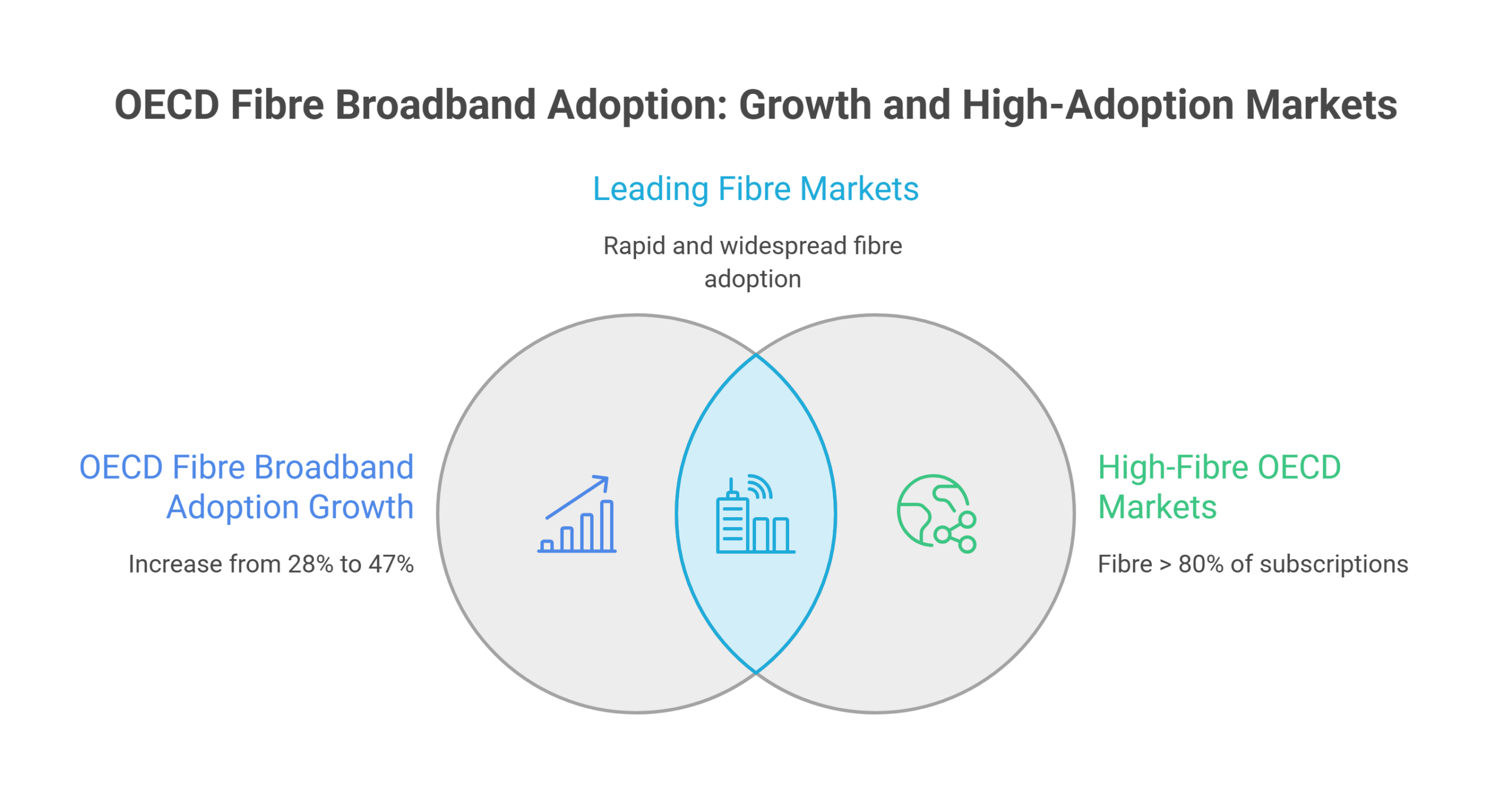
Key Takeaway: Fibre is becoming the principal fixed access technology in a growing number of mature markets, increasing the importance of migration and legacy network retirement.
Managing Operational Complexity and Regulatory Coordination
The transition from metallic lines to optical paths extends beyond civil works and requires operators to manage copper and fibre networks in parallel during migration. Full fibre expansion can therefore change operating priorities as operators coordinate customer transfers, wholesale access and the gradual withdrawal of legacy services. The case for retiring copper is partly linked to the maintenance requirements of ageing metallic infrastructure and the cost of continuing to run parallel access networks.
In the United Kingdom, Openreach has identified the move toward a fibre-first model as an important part of managing reactive maintenance requirements associated with legacy copper. The operational challenge is to sequence migration in a way that limits disruption while allowing operators to reduce dependence on the older network.
The migration process can create different requirements across customer groups and network layers. Wholesale providers need sufficient notice to transfer services, while operators must maintain reliable access while both technologies remain active. The timing of commercial and technical closure therefore becomes an important part of network planning. Where migration is incomplete, operators may still need to maintain legacy equipment and support arrangements until remaining services are transferred.
Regulatory coordination is becoming more important as commercial and technical closure progress. Notice periods and migration processes can give wholesale providers time to move customers and services before legacy infrastructure is withdrawn. In France, Arcep has established a multi-phase programme linking technical copper closure to the availability of fibre alternatives.
This means full fibre expansion must be considered alongside service continuity and market access rather than as a standalone construction programme. Operators must also account for legacy services that can require dedicated migration arrangements, including alarms, monitoring systems and other applications that historically depended on copper connectivity. These requirements can extend the transition period even where fibre availability is already high.
Decommissioning and Infrastructure Consolidation
Once migration reaches an advanced stage, operators can begin the physical decommissioning of legacy infrastructure. This may involve removing switching equipment, managing copper recovery and assessing whether exchange sites can be repurposed. As full fibre expansion matures in established markets, these activities become part of the wider network investment cycle rather than a separate infrastructure issue. The resulting operating model can place greater emphasis on a consolidated optical access network, but the pace of that consolidation depends on migration progress, regulatory conditions and the services that remain on the legacy network.
Fibre Migration Redefining the Fixed Network Investment Cycle
The fixed-network transition is moving beyond the question of how widely fibre can be deployed and toward how effectively legacy infrastructure can be migrated and retired. Fibre’s rising share of fixed broadband subscriptions across OECD markets provides evidence of that change, while national programmes show that copper closure requires coordinated technical, commercial and regulatory processes. As full fibre expansion continues across mature markets, the focus is increasingly shifting toward service migration, network consolidation and the conditions required to withdraw legacy access infrastructure.
For operators, this means investment planning extends beyond construction to migration sequencing, wholesale coordination and eventual asset removal. The pace will differ because network starting points, regulation and migration requirements vary between markets. The significance of this transition for fixed-network investment lies in a shift toward fibre deployment becoming the foundation for replacing, rather than simply supplementing, older copper networks.