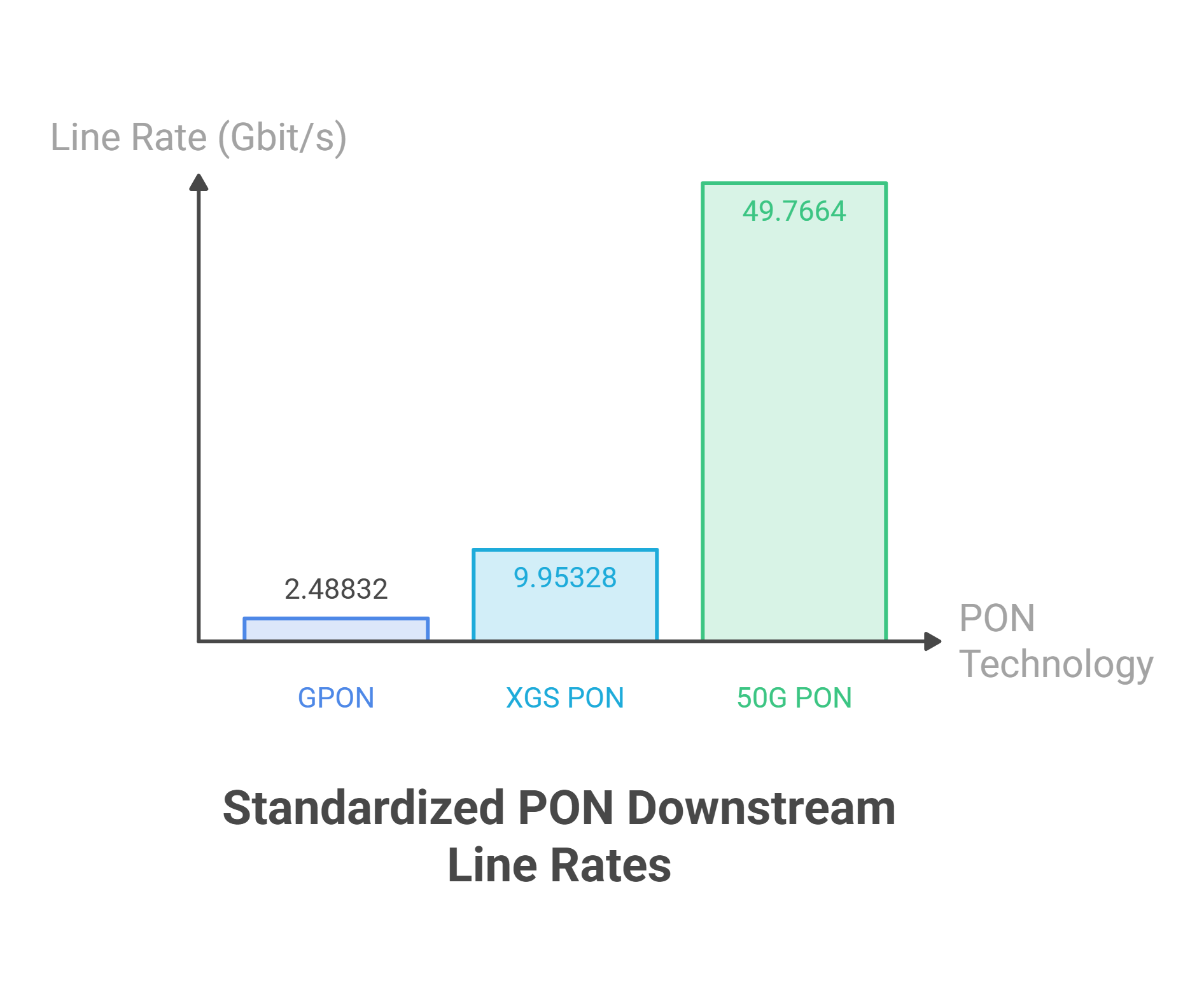






















The evolution of fibre access networks is entering a new phase as operators look beyond initial full fibre deployment toward higher capacity on infrastructure that is already in place. 50G PON is emerging within this transition as a standards based upgrade path for operators seeking to increase access capacity without treating each new generation as a complete network rebuild. The ITU T G.9804.3 specification defines 50G PON with a nominal downstream line rate of 49.7664 Gbit/s, while supporting different upstream configurations. This places the technology within a broader progression from GPON and XGS PON toward substantially higher capacity optical access.
The significance of 50G PON lies not only in its higher line rate but also in how it can coexist with earlier PON generations. ITU T G.9805 defines mechanisms that allow multiple PON technologies to operate over a common optical distribution network, including combinations involving GPON, XGS PON and 50G PON. This approach can allow operators to introduce new optical line terminals and compatible customer equipment while continuing to support existing services during migration. For networks with extensive fibre footprints, that evolutionary model can be important because the physical optical distribution network represents a significant installed asset.
Operator activity is also moving across different stages of technical validation and deployment. China Mobile and ZTE have demonstrated a three generation architecture combining GPON, 10G PON and 50G PON, while Orange has tested 50G PON under live network conditions in France. In the United States, Google Fiber and Nokia have conducted a live network trial involving 50G PON alongside other PON technologies. These developments show that 50G PON is being evaluated not simply as a faster residential access technology, but as part of a broader strategy for evolving existing fibre networks.
The upgrade path also introduces new engineering considerations. Operators must assess optical budgets, wavelength arrangements, OLT architecture and compatible optical network units while determining where additional capacity is justified. This makes the transition less about replacing one access generation with another and more about managing multiple generations within the same fibre environment. As existing networks face rising requirements, the ability to increase capacity while preserving substantial elements of the installed optical foundation is becoming an important consideration for access-network planning.
Multi Generation Coexistence Supporting Fibre Network Upgrades
The main operational challenge in deploying 50G PON is managing the transition without disrupting services already running across established fibre access networks. Operators can use coexistence architectures to support GPON, XGS PON and 50G PON over a common optical distribution network, allowing newer capacity to be introduced while earlier services remain active. ITU T G.9805 defines several approaches for this multi generation environment, including coexistence elements and multi PON modules. This gives operators greater flexibility in deciding when to replace optical line terminals and customer equipment rather than requiring a single network wide migration.
The approach also changes how access network investments are planned. Instead of treating each PON generation as a separate infrastructure cycle, operators can preserve the underlying fibre distribution network while upgrading active optical equipment and endpoints where additional capacity is justified. Google Fiber and Nokia demonstrated this model in a live network trial in the United States, while China Mobile and ZTE have demonstrated a three generation architecture supporting GPON, 10G PON and 50G PON. These examples indicate that migration can be staged around network requirements, equipment readiness and service priorities.