


















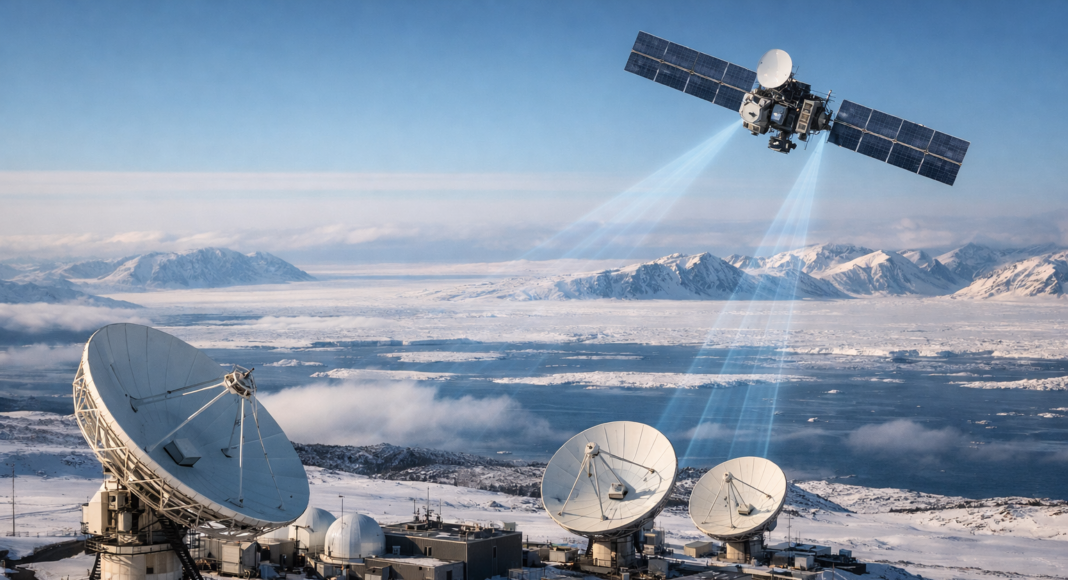

Telesat has signed the largest contract in its history, a roughly C$1.63 billion agreement with Canada’s Defence Investment Agency to provide the Canadian military with secure communications across the Arctic. The Telesat defence contract also finances a significant expansion of the company’s Lightspeed low Earth orbit satellite constellation.
The agreement covers military Ka-band services beginning in 2028. It includes two five-year options valued at approximately C$142 million each, which would bring the total value of the Telesat defence contract to around C$1.92 billion and extend the service period to 15 years.
The contract gives Telesat an anchor defence customer before Lightspeed begins service and supplies funding to increase the number of fully financed satellites in the constellation from 156 to 225. Telesat said the network remains on schedule to begin global service in the first quarter of 2028.
Expanded Satellite Constellation and Manufacturing Order
MDA Space was already under contract to manufacture 198 Lightspeed satellites, but Telesat’s previous financing plan covered only the first 156 spacecraft needed to begin global service. The company had planned to fund the remaining 42 with revenue generated after the network entered operation.
Milestone payments from the Canadian government, beginning in the third quarter of 2026, will instead fund those 42 satellites and an additional 27 spacecraft. The Telesat defence contract therefore increases the number of fully funded satellites by 69 while raising MDA’s manufacturing order by 27, from 198 to 225.
Under the agreement, Lightspeed will provide military Ka-band connectivity between 65 and 90 degrees north latitude, covering Canada’s Arctic region. Military Ka-band refers to frequencies reserved for government and defence communications, used by Canada and its allies for secure, high-capacity satellite links.
“This contract ensures the Canadian Armed Forces will have access to secure, resilient and sovereign connectivity years earlier than originally planned,” said Telesat chief executive Dan Goldberg.
Telesat announced in March that it would replace 500 megahertz of planned commercial Ka-band spectrum on Lightspeed’s user links with an equal amount of military Ka-band. The frequencies are adjacent, allowing the company to make the change without altering its launch schedule and with what it described at the time as a modest increase in programme costs. Under the expanded plan, all 225 Lightspeed satellites will carry 500 megahertz of military Ka-band capacity alongside commercial spectrum.
MDA said the additional work increases the value of its Lightspeed contract by about C$337 million. That amount includes the 27 newly ordered satellites, the military Ka-band modifications and other long-lead equipment. The spacecraft will be assembled at MDA’s manufacturing facility in Montreal.
Arctic Communications Programme and Strategic Scope
The award represents the first phase of the military Ka-band portion of Canada’s Enhanced Satellite Communications Project–Polar, known as ESCP-P. A separate agreement is expected to cover user terminals, ground and control infrastructure, network integration, training and support.
ESCP-P is intended to provide wideband and narrowband Arctic satellite communications to Canadian forces operating in the region, where terrestrial infrastructure is limited and geostationary satellites sit close to the horizon, making reliable links more difficult. Canada has tied the programme to Arctic sovereignty and its commitments to the North American Aerospace Defence Command and NATO.
The Telesat defence contract also accelerates a broader shift in the company’s business towards military customers. Goldberg told investors on 4 August that Telesat now expects defence customers to account for about 46 per cent of company revenue in 2032, compared with an earlier projection of 14 per cent. The revised mix reflects the addition of military Ka-band to the Lightspeed satellite constellation and the Canadian contract, which expand the network’s potential market among NATO members and allied governments.
The military spectrum will allow the Lightspeed satellite constellation to communicate with compatible Canadian and allied terminals while supporting both defence and commercial users on the same underlying network. Lightspeed’s planned optical links will allow data to move between satellites before being routed to the ground.
Telesat said the added satellites will be launched on SpaceX Falcon 9 rockets, including launches already under contract and another mission subject to completion of a launch services agreement. The larger constellation gives Telesat more capacity to pursue military business beyond Canada while retaining capacity for enterprise and commercial customers through this landmark Telesat defence contract.