




















The global transition toward fifth-generation wireless technology is often discussed in terms of radio frequencies and smartphone capabilities, yet the true foundation of this revolution lies deep underground and across ocean floors. As the world demands instantaneous data access, the role of 5G optical networks has become the silent engine driving this unprecedented era of high speed connectivity growth. Without a robust optical backbone, the promises of 5G ultra-low latency, massive device density, and gigabit speeds would remain theoretical. The integration of advanced fiber optics into the telecom infrastructure is not merely an upgrade; it is a fundamental reimagining of how data moves across the planet.
The Critical Role of Fiber in the 5G Ecosystem
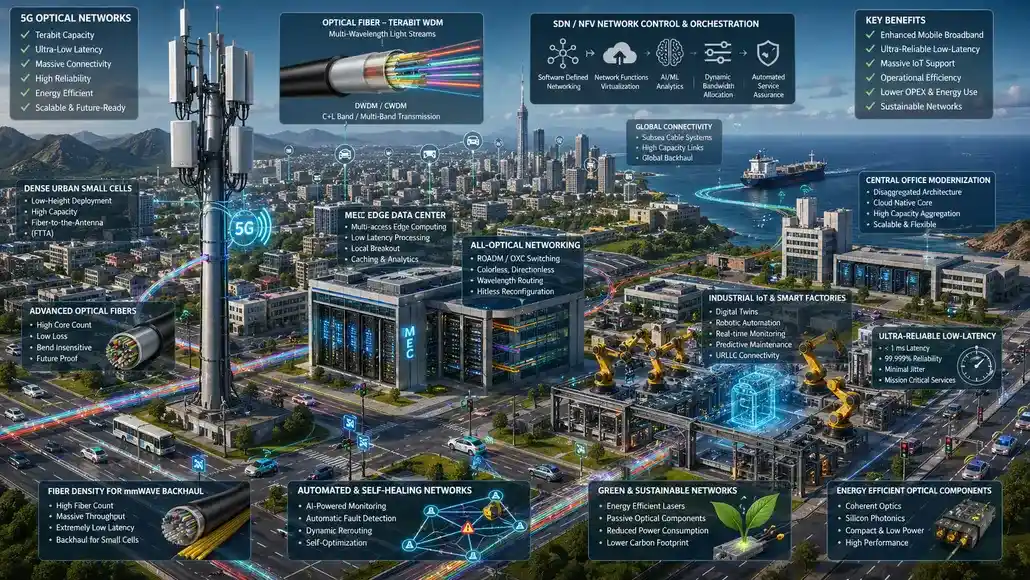
The relationship between wireless signals and physical cables is more symbiotic than most users realize. While 5G represents a wireless standard, the journey of a data packet from a mobile device to a server is almost entirely conducted via light through glass. The shift toward higher frequency bands, such as millimeter wave (mmWave), necessitates a much denser network of small cells. Each of these cells requires a dedicated, high-capacity connection to the core network, a requirement that only optical fiber technology can satisfy. This architectural shift from traditional copper or microwave backhaul to fiber-to-the-antenna (FTTA) is the primary catalyst for the current surge in optical deployments.
By leveraging advanced fiber optics, telecommunication providers are able to overcome the physical limitations of legacy systems. Standard copper wires simply lack the bandwidth-distance product required to carry the massive data loads generated by 5G networks. In contrast, modern optical fibers can transport terabits of data over vast distances with minimal signal degradation. This scalability ensures that as consumer demand for high-definition streaming, cloud gaming, and virtual reality grows, the underlying infrastructure can be upgraded through software and terminal equipment changes without needing to dig up and replace the physical cables themselves.
Advancing Low Latency Through Optical Innovation
One of the most transformative aspects of the 5G standard is its focus on latency the delay between a command and a response. For applications like autonomous driving, remote robotic surgery, and real-time industrial automation, even a millisecond of delay can be catastrophic. Achieving “ultra-reliable low latency communication” (URLLC) requires more than just fast radio waves; it requires a streamlined optical transport layer. Traditional network designs often involved multiple layers of electronic switching and routing, each adding a small amount of “jitter” and delay. 5G optical networks are moving toward all-optical switching and edge computing to minimize these bottlenecks.
By moving processing power closer to the end-user a concept known as Multi-access Edge Computing (MEC) operators can drastically reduce the physical distance data must travel. However, connecting these distributed edge data centers requires a high-density, low-latency mesh of fiber optics. Innovation in Wavelength Division Multiplexing (WDM) allows multiple data streams to be sent simultaneously over a single fiber strand by using different colors of light. This technology maximizes the efficiency of the existing fiber plant, ensuring that low latency networks can handle the surge in traffic from billions of IoT devices without sacrificing performance or speed.
Scalable Telecom Infrastructure for a Digital Future
The financial and logistical scale of upgrading global telecom infrastructure for 5G is staggering. It involves not just the installation of new cables, but the complete modernization of central offices into data-center-like facilities. This convergence of IT and telecommunications is made possible by Software-Defined Networking (SDN) and Network Function Virtualization (NFV), both of which rely on high-speed optical interconnects. A scalable infrastructure is one that can adapt to changing traffic patterns in real-time. For instance, during a major sporting event, an optical network can dynamically allocate more bandwidth to a specific geographic area through automated optical path reconfiguration.
Furthermore, the environmental impact of this growth cannot be ignored. Optical communication is significantly more energy-efficient than traditional electronic transmission. As data consumption skyrockets, the ability of 5G optical networks to deliver more bits per watt is essential for the sustainability of the telecommunications industry. The transition to “green” optical networks involves using more efficient lasers, passive optical components, and intelligent power management systems. This focus on efficiency ensures that high speed connectivity growth does not come at an unacceptable environmental cost, aligning technological progress with global sustainability goals.
Key Takeaways for the Future of Connectivity
The first essential takeaway is that the success of 5G is inextricably linked to the density and quality of the underlying optical fiber footprint. As operators deploy more small cells to handle high-frequency signals, the demand for fiber-to-the-x (FTTX) solutions will continue to accelerate, making optical infrastructure the most valuable asset in the modern telecom portfolio. This physical layer is the only medium capable of providing the future-proof bandwidth required for the next decade of digital transformation.
The second key point involves the shift toward intelligent, automated optical management. The complexity of 5G optical networks, with their dynamic traffic demands and edge computing nodes, necessitates a move away from manual configuration. Intelligent automation, powered by telemetry and real-time analytics, will allow networks to self-heal and optimize performance. This evolution ensures that high speed connectivity remains consistent and reliable, regardless of the load, providing a seamless experience for both industrial and consumer applications.
Industrial Transformation and the Optical Backbone
Beyond consumer smartphones, the real impact of 5G optical networks is seen in the industrial sector. Smart factories utilize thousands of sensors to monitor production lines in real-time. These sensors generate a constant stream of data that must be analyzed instantly to prevent defects or machine failures. The high speed connectivity provided by a fiber-rich 5G environment allows for the implementation of “digital twins” virtual replicas of physical systems that update in real-time. This level of synchronization is only possible when the latency of the optical transport network is kept to an absolute minimum.
In the realm of public safety and smart cities, 5G optical networks enable high-definition surveillance, intelligent traffic management systems, and real-time emergency response coordination. By providing a reliable and high-capacity link for municipal services, optical technology enhances the quality of life for urban populations. The ability to process vast amounts of visual data from street cameras and environmental sensors allows city planners to make data-driven decisions that improve efficiency and safety. This holistic integration of technology into the fabric of society depends on a telecom infrastructure that is both resilient and immensely powerful.
Conclusion: The Horizon of Optical Connectivity
As we look toward the future, the momentum behind 5G optical networks shows no signs of slowing. The ongoing investment in fiber innovation and infrastructure upgrades is paving the way for even more advanced technologies, including the eventual transition to 6G. The lessons learned during the 5G rollout the importance of fiber density, the necessity of low latency, and the value of network automation will serve as the blueprint for the next generation of connectivity. High speed connectivity is no longer a luxury; it is a foundational requirement for economic growth and social progress in the 21st century.
The commitment to expanding and refining our optical networks ensures that we are prepared for the “Internet of Everything.” As more devices, vehicles, and systems become interconnected, the capacity of our glass highways will determine the limits of our collective imagination. By continuing to push the boundaries of optical fiber technology, the telecommunications industry is not just building a faster internet; it is building the infrastructure of a more connected, efficient, and intelligent world.