
















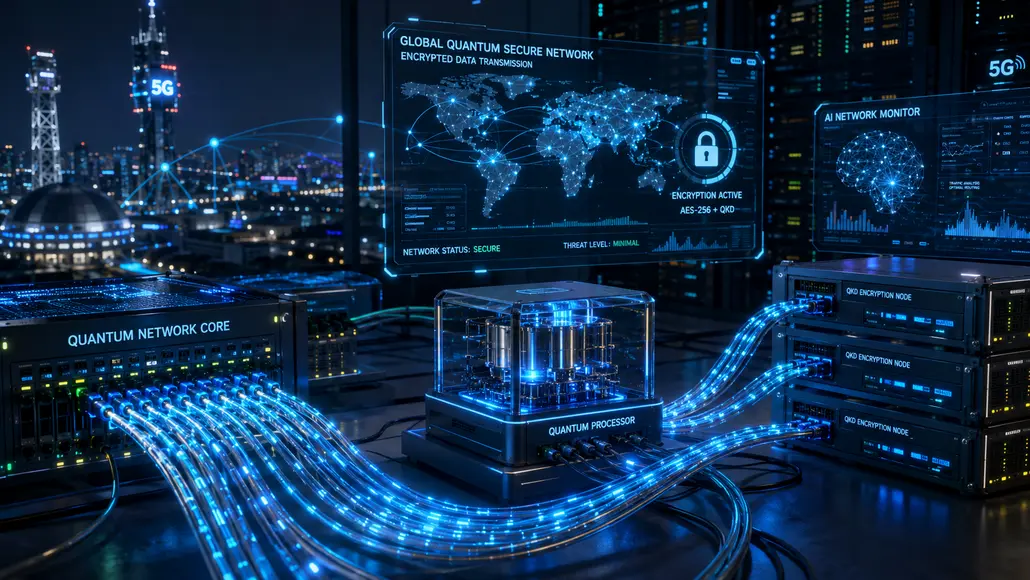

The modern world is built on a foundation of digital trust. Every financial transaction, medical record, and diplomatic communication relies on the assumption that our data is protected by encryption. However, this trust is facing a looming existential threat. The eventual arrival of large-scale quantum computers will render most of our current cryptographic standards the math-based systems we have used for decades effectively useless. To prevent a global security collapse, the telecommunications industry is racing to deploy quantum secure networks. These systems move beyond traditional mathematics, instead leveraging the immutable laws of quantum physics to ensure that digital connectivity remains safe, private, and resilient in a post-quantum world.
The Vulnerability of Classical Cryptography
Most of today’s secure communication is based on the difficulty of solving certain mathematical problems, such as factoring extremely large numbers. While these problems take classical computers thousands of years to solve, a quantum computer using Shor’s Algorithm could solve them in minutes. This creates a “harvest now, decrypt later” risk, where malicious actors collect encrypted data today with the intention of unlocking it once quantum technology matures. This threat has made the development of quantum secure networks a matter of urgent national and economic security. Strengthening digital connectivity requires a fundamental shift in how we approach the privacy of our information.
The solution lies in two primary areas: Post-Quantum Cryptography (PQC) and Quantum Key Distribution (QKD). PQC involves developing new mathematical algorithms that are resistant even to quantum attacks, while QKD uses the quantum properties of light to share secret keys. Unlike classical keys, which can be copied without detection, a quantum key is governed by the observer effect. If an eavesdropper attempts to measure the quantum state of a photon used in the key exchange, the state is altered, and the intrusion is instantly detected. This “physics-based” security provides a level of protection that no amount of computing power can ever overcome.
Implementing Quantum Key Distribution in Telecom
The practical implementation of quantum secure networks within the existing telecom infrastructure involves sending quantum-encoded photons through standard fiber optic cables. This process is known as Quantum Key Distribution (QKD). In a typical QKD setup, a transmitter (Alice) and a receiver (Bob) establish a shared secret key by exchanging a series of single photons. Any attempt to intercept these photons changes their physical properties, causing the key to be discarded and the security breach to be flagged. Once a secure key is established, it can be used with traditional symmetric encryption to protect massive amounts of data at high speeds.
However, QKD faces significant physical challenges. Single photons are delicate and can be absorbed or scattered as they travel through glass, limiting the distance of a quantum link to approximately 100 to 150 kilometers. To build larger quantum secure networks, the industry is developing “quantum repeaters” devices that can extend the range of the signal without compromising its quantum state. Until these repeaters are fully commercialized, many organizations are utilizing “trusted node” networks, where the quantum key is decrypted and re-encrypted at secure locations along the route. This hybrid approach allows for the strengthening of digital connectivity across metropolitan and regional distances today.
Enhancing Cyber Resilience and Data Privacy
The primary benefit of transitioning to quantum secure networks is the dramatic increase in cyber resilience. In a world where cyberattacks are becoming more frequent and sophisticated, the ability to detect an intrusion at the physical layer is a game-changer. For critical infrastructure providers, such as power grids and transportation systems, quantum security ensures that the command-and-control links remain protected against even the most advanced adversaries. This protection is not just about preventing data theft; it is about ensuring the operational stability of the modern world.
Furthermore, quantum security addresses the growing public demand for data privacy. As more of our personal lives move online—from genomic data to private conversations—the need for long-term “evergreen” security is paramount. Quantum secure networks provide the assurance that information shared today will remain private for decades to come, regardless of how powerful computers become. This long-term protection is essential for maintaining the digital trust required for the continued expansion of the global economy. By protecting telecom data systems at a fundamental level, we are creating a more secure and reliable digital environment for all citizens.
Building the Future Quantum Internet
As we look toward the future, the goal is the creation of a “Quantum Internet” a global network that allows for the exchange of quantum information between quantum computers. This goes beyond just secure keys; it enables “blind quantum computing,” where a user can run a program on a remote quantum computer without the provider ever seeing the data or the code. Quantum secure networks are the first step in this journey, providing the physical infrastructure needed for the next great leap in human connectivity.
The development of space-based quantum communication is also accelerating. Satellites can be used as “orbital repeaters” to bridge the gap between continents, overcoming the distance limitations of terrestrial fiber. By sending quantum signals through the vacuum of space, we can create a truly global quantum secure network that connects any two points on Earth with absolute security. This vision of a “quantum-safe world” is no longer science fiction; it is a technical reality that is being built today by the innovators of the telecommunications industry.
Conclusion: Securing the Digital Frontier
The strengthening of digital connectivity through quantum secure networks is one of the most significant challenges of our time. By embracing the principles of quantum physics, we are building a shield that can protect our digital society from the threats of tomorrow. This transition is about more than just technology; it is about preserving the privacy, security, and trust that make modern life possible.
As we continue to push the boundaries of what is possible in secure communication, the role of quantum technology will only grow in importance. It is the ultimate safeguard for our data and the foundation of a more resilient digital future. By investing in quantum secure networks today, we are ensuring that the digital world we build remains open, safe, and connected for generations to come. The era of quantum security is here, and it is lighting the way to a more secure and prosperous global community.