






















Key Takeaways for Next-Generation Networking
- The first primary takeaway is that we are moving away from a “one-size-fits-all” approach to optical fiber. Different applications will demand different types of next gen fiber optics. While data centers might prioritize silicon photonics and short-reach multi-mode fibers, long-haul and subsea operators will lean toward multi-core and ultra-low-loss fibers. This specialization ensures that each part of the global telecom network is optimized for its specific role, balancing cost, capacity, and performance.
- The second key point is the increasing importance of “non-silica” materials and complex glass structures. Whether it is hollow core designs or fibers doped with exotic elements to broaden the usable spectrum (the L-band and S-band), the focus is on expanding the usable “real estate” within the light spectrum. This expansion is essential to stay ahead of the “Shannon Limit” the theoretical maximum amount of data that can be transmitted over a single channel. By innovating at the material level, we are pushing that limit further into the future.
For decades, the standard single-mode optical fiber has been the workhorse of the digital age, silently carrying the vast majority of the world’s internet traffic. However, as we enter an era defined by artificial intelligence, high-definition streaming, and the massive data requirements of cloud computing, the physical limits of traditional glass are being reached. This has sparked a global race to develop next gen fiber optics—technologies that move beyond the constraints of standard silica cores to provide exponential leaps in data transmission speed and efficiency. The evolution of our digital society depends on our ability to transmit more information, faster than ever before, through the thin strands of glass that connect our continents.
Breaking the Speed of Light Barrier with Hollow Core Fiber
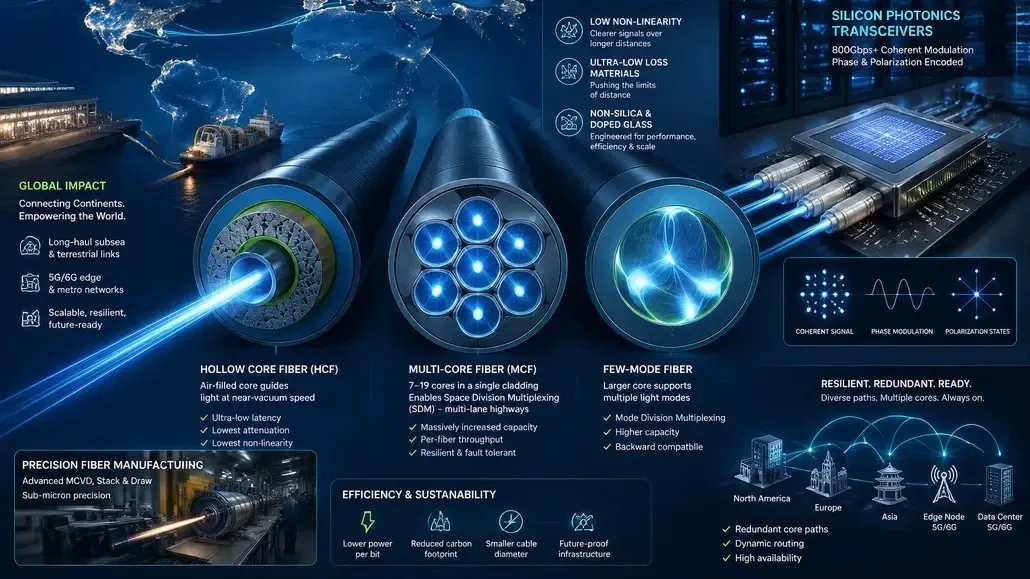
One of the most exciting breakthroughs in the field of next gen fiber optics is the development of Hollow Core Fiber (HCF). In a standard optical fiber, light travels through a solid core of silica glass. While glass is incredibly transparent, it is still a physical medium that slows down light by approximately 31% compared to its speed in a vacuum. Hollow core fibers, as the name suggests, guide light through an air-filled or vacuum-filled center using complex microstructures. This allows light to travel at nearly the full speed of light in a vacuum, significantly reducing latency and increasing the potential for ultra-fast data transmission.
The implications of HCF are profound, particularly for time-sensitive applications like high-frequency trading, where every nanosecond counts. Beyond just speed, hollow core fibers exhibit lower “non-linear” effects. In solid glass, high-power light signals can interact with the material itself, causing distortion and limiting the amount of power that can be sent through the cable. By removing the solid glass core, HCF allows for higher power levels and clearer signals over longer distances. While manufacturing these complex structures at scale remains a challenge, the potential for HCF to redefine the limits of optical communication is undeniable.
Space Division Multiplexing and Multi-Core Innovation
As the demand for bandwidth expansion continues to skyrocket, researchers are looking for ways to pack more data into a single fiber strand. Traditional fibers carry a single “mode” of light, effectively acting as a one-lane highway. Next gen fiber optics are embracing Space Division Multiplexing (SDM) to create multi-lane digital superhighways. This is achieved through the development of multi-core fibers (MCF) and few-mode fibers. A multi-core fiber contains several independent glass cores within a single cladding, allowing multiple data streams to travel in parallel without interfering with each other.
Imagine a single fiber cable that can carry seven, twelve, or even nineteen times the data of a standard cable without significantly increasing its physical size. This innovation is critical for subsea cables and long-haul telecom networks where the cost of laying new cables is astronomical. By maximizing the capacity of each individual strand, MCF technology provides a sustainable path for bandwidth growth. Furthermore, few-mode fibers use a slightly larger core to allow a few distinct patterns of light to travel simultaneously. When combined with sophisticated digital signal processing, these techniques allow for a massive increase in the aggregate data transmission speed across global networks.
The Role of Advanced Photonics Technology
The physical fiber is only one part of the equation; the equipment that sends and receives the light the photonics technology must also evolve. Next-generation transceivers are utilizing silicon photonics to integrate complex optical functions onto a single chip. This miniaturization allows for higher port density in data centers and lower power consumption. By combining the processing power of traditional electronics with the speed of light-based communication, silicon photonics is bridging the gap between computing and networking.
Advanced modulation formats are another key component of photonics innovation. Instead of simply turning a laser on and off (like Morse code), modern systems use “coherent” technology to manipulate the phase and polarization of light. This allows for many bits of information to be encoded into a single pulse of light. When coupled with next gen fiber optics, these advanced modulation techniques enable transmission speeds of 800Gbps, 1.2Tbps, and beyond. This synergy between the physical medium and the optoelectronic hardware is what makes the current era of optical communication so transformative.
Global Impact on Telecom Networks and Connectivity
The deployment of next gen fiber optics has far-reaching consequences for global connectivity. In developing regions, high-capacity long-haul fibers can bring affordable high-speed internet to millions, bridging the digital divide. In developed urban areas, these fibers support the backbone of 5G and future 6G networks, enabling the “Internet of Things” to flourish. The efficiency gains provided by new fiber technologies also contribute to a smaller carbon footprint for the telecommunications industry, as more data can be moved with less energy-intensive amplification and regeneration.
Furthermore, the resilience of these next-generation networks is significantly improved. Multi-core fibers, for example, can offer inherent redundancy; if one core is damaged, traffic can be rerouted through others within the same strand. This reliability is vital for the critical infrastructure that supports our financial systems, healthcare networks, and governmental communications. As we become more dependent on the cloud, the “unbreakable” nature of our optical connections becomes a matter of national and economic security.
Conclusion: Shaping the Future of Data Transmission
The journey toward faster, more efficient data transmission is a continuous process of innovation and discovery. Next gen fiber optics represent the pinnacle of our current understanding of physics and materials science, applied to the goal of connecting the human race. From the air-filled channels of hollow core fibers to the multi-lane efficiency of multi-core designs, these technologies are ensuring that our digital infrastructure remains robust in the face of exponential data growth.
As we look forward, the integration of advanced photonics and novel fiber structures will continue to blur the lines between what is possible and what is reality. The next decade will likely see these technologies transition from the research lab to widespread commercial deployment, powering the next wave of technological breakthroughs. By investing in the development of next gen fiber optics, we are not just upgrading our cables; we are building the foundation for a faster, smarter, and more interconnected world.