






















Key Takeaways for Edge-to-Cloud Integration
- The first primary takeaway is that optical links cloud edge are the “great enabler” of the distributed compute model. As the volume of data generated at the edge continues to skyrocket, the physical transport layer must be able to keep pace. Fiber optics provide the only future-proof medium capable of supporting the multi-terabit speeds that will be required by the next generation of AI and IoT applications. Investing in a fiber-rich edge architecture is a prerequisite for any organization looking to lead in the digital economy.
- The second key point is the importance of “resilience” in the edge-to-cloud connection. Unlike traditional enterprise networks, the links connecting edge nodes are often exposed to harsh environments or located in remote areas. Using advanced optical links with built-in monitoring and self-healing capabilities ensures that the digital transformation remains uninterrupted, even in the face of physical damage or network congestion. This reliability is vital for critical services like emergency response coordination and remote healthcare, where a loss of connectivity can have life-altering consequences.
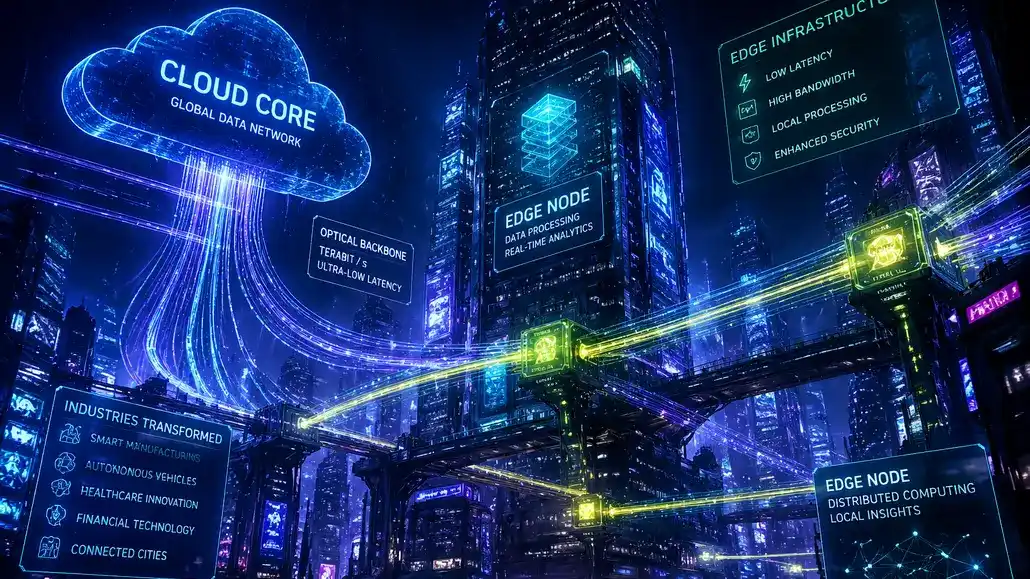
The architecture of the internet is currently undergoing a profound rebalancing. For the last decade, the trend was toward extreme centralization, with data and processing power concentrated in a few massive, remote facilities. Today, the rise of latency-sensitive applications like autonomous vehicles, industrial robotics, and augmented reality is driving a shift toward the “edge” moving compute resources closer to where the data is actually generated. This distributed model creates a complex networking challenge: how to connect these far-flung nodes with the central core without sacrificing performance. The answer lies in the deployment of high-performance optical links cloud edge, which provide the high-speed, low-latency foundation necessary for this new digital era.
Bridging the Gap Between Centralized and Distributed Compute
The relationship between cloud computing and edge networks is often presented as a competition, but in reality, they are deeply complementary. The cloud provides the massive storage and processing power needed for complex, long-term analysis, while the edge provides the near-instantaneous response times required for local action. However, for this hybrid model to work, the data must be able to move between these two layers with zero friction. Traditional copper or microwave backhaul systems are simply unable to handle the sheer volume of traffic generated by modern edge deployments. Optical links are the only medium capable of providing the terabit-scale bandwidth required to synchronize these distributed resources.
The acceleration provided by optical links cloud edge is most apparent in the reduction of “round-trip time.” When an edge device such as a smart traffic sensor needs to consult the central cloud for a complex decision, every millisecond of delay in the transmission link adds up. By using fiber optics to connect the edge to the core, operators can minimize the physical latency of the network. This ensures that the digital transformation of industries like manufacturing and healthcare can proceed without the “lag” that would otherwise render real-time remote control or automated monitoring impossible.
Optimizing Data Transfer Speed in the Age of 5G
The rollout of 5G has been a major catalyst for the growth of edge networks. To support the high device density and ultra-low latency promised by the 5G standard, operators must deploy thousands of “small cells” and edge data centers. Each of these nodes requires a high-capacity link to the rest of the network. Optical links cloud edge are the “nervous system” of this infrastructure, providing the raw data transfer speed needed to move massive amounts of telemetry and user data in real-time. Without a robust fiber backbone, the 5G network would be like a high-performance engine restricted by a tiny fuel line.
Furthermore, the use of Wavelength Division Multiplexing (WDM) on these optical links allows operators to maximize the efficiency of their existing fiber footprint. By sending multiple data streams over different colors of light, a single strand of glass can support the traffic of an entire neighborhood or industrial park. This scalability is essential for the long-term viability of edge networks, as it allows for capacity upgrades through simple hardware changes at the endpoints, rather than the expensive and time-consuming process of laying new physical cables.
Driving Digital Transformation Across Industries
The impact of accelerated optical links is felt across every sector of the global economy. In the retail industry, edge networks connected by fiber enable real-time inventory tracking and personalized customer experiences through augmented reality displays. In the energy sector, optical links cloud edge allow for the real-time monitoring of smart grids, helping to balance supply and demand and integrate renewable energy sources more effectively. This level of synchronization is only possible when the underlying communication infrastructure is capable of handling high-speed, bidirectional data flow without interruption.
Perhaps the most dramatic example of this digital transformation is found in the modern “smart factory.” Here, thousands of sensors and actuators are connected to an on-site edge server that processes data locally to ensure the precision of the assembly line. At the same time, the edge server is connected via optical links to the central cloud for predictive maintenance analysis and global supply chain optimization. This seamless integration of local and global intelligence is the hallmark of Industry 4.0, and it is made possible entirely by the reliability and speed of light-based communication.
Future Horizons: All-Optical Edge Networking
As we look toward the future, we can expect to see the “all-optical” concept extend all the way to the edge of the network. Currently, most edge nodes still involve a transition from optical to electrical signals for processing. However, the development of photonic computing and optical switching at the edge will eventually allow data to remain in the form of light throughout its entire journey. This would lead to even lower latency and massive energy savings, further accelerating the digital transformation of our society.
Additionally, the integration of “free-space optics” (FSO) will allow for the extension of optical links to areas where laying fiber is difficult or impossible. By using lasers to transmit data through the air, operators can connect remote edge nodes or temporary industrial sites with the same high-speed performance as a fiber-connected facility. This flexibility will ensure that the benefits of the cloud-edge synergy can reach every corner of the globe, regardless of the local terrain or infrastructure limitations.
Conclusion: The Optical Foundation of the Modern Internet
The acceleration of cloud and edge networks through optical links is more than just a technical upgrade; it is a fundamental shift in how we build and interact with the digital world. By providing the high-capacity, low-latency bridges between centralized power and decentralized action, fiber optics are making the “Internet of Everything” a reality. This infrastructure is the foundation upon which the innovations of the next century will be built.
As the demand for real-time data and intelligent services continues to grow, the role of optical links cloud edge will only become more critical. By continuing to innovate at the physical layer, the telecommunications industry is ensuring that our digital infrastructure remains robust, efficient, and capable of supporting the infinite possibilities of the human imagination. The future of connectivity is bright, fast, and driven by the speed of light.