


















Enterprise connectivity is undergoing one of its most significant transformations since the commercial adoption of mobile broadband. As organizations accelerate digital transformation, the role of the Internet of Things (IoT) is expanding far beyond connecting devices. Today’s enterprises require intelligent, secure, and highly scalable network ecosystems capable of supporting real-time decision-making, distributed operations, and increasingly complex digital services.
This evolution is redefining Telecom IoT. What was once viewed primarily as a connectivity service has become an integrated technology ecosystem that combines advanced wireless networks, artificial intelligence (AI), edge computing, satellite communications, and cloud-native platforms. Together, these technologies are enabling enterprises to collect, process, and act on operational data with greater speed, accuracy, and efficiency than ever before.
Industry adoption reflects this growing momentum. According to Berg Insight, global cellular IoT connections reached 4.2 billion by the end of 2025, representing an 11% increase compared with the previous year. The research firm expects that figure to exceed 6.5 billion by 2030 as organizations across manufacturing, logistics, healthcare, utilities, transportation, and smart city projects continue expanding connected infrastructure.
Rather than simply enabling communication between devices, Telecom IoT is becoming the digital backbone of enterprise operations. The convergence of 5G, AI, satellite connectivity, and edge computing is allowing organizations to build resilient, data-driven environments that improve operational efficiency while supporting long-term business growth.
Telecom IoT Is Evolving Beyond Traditional Connectivity
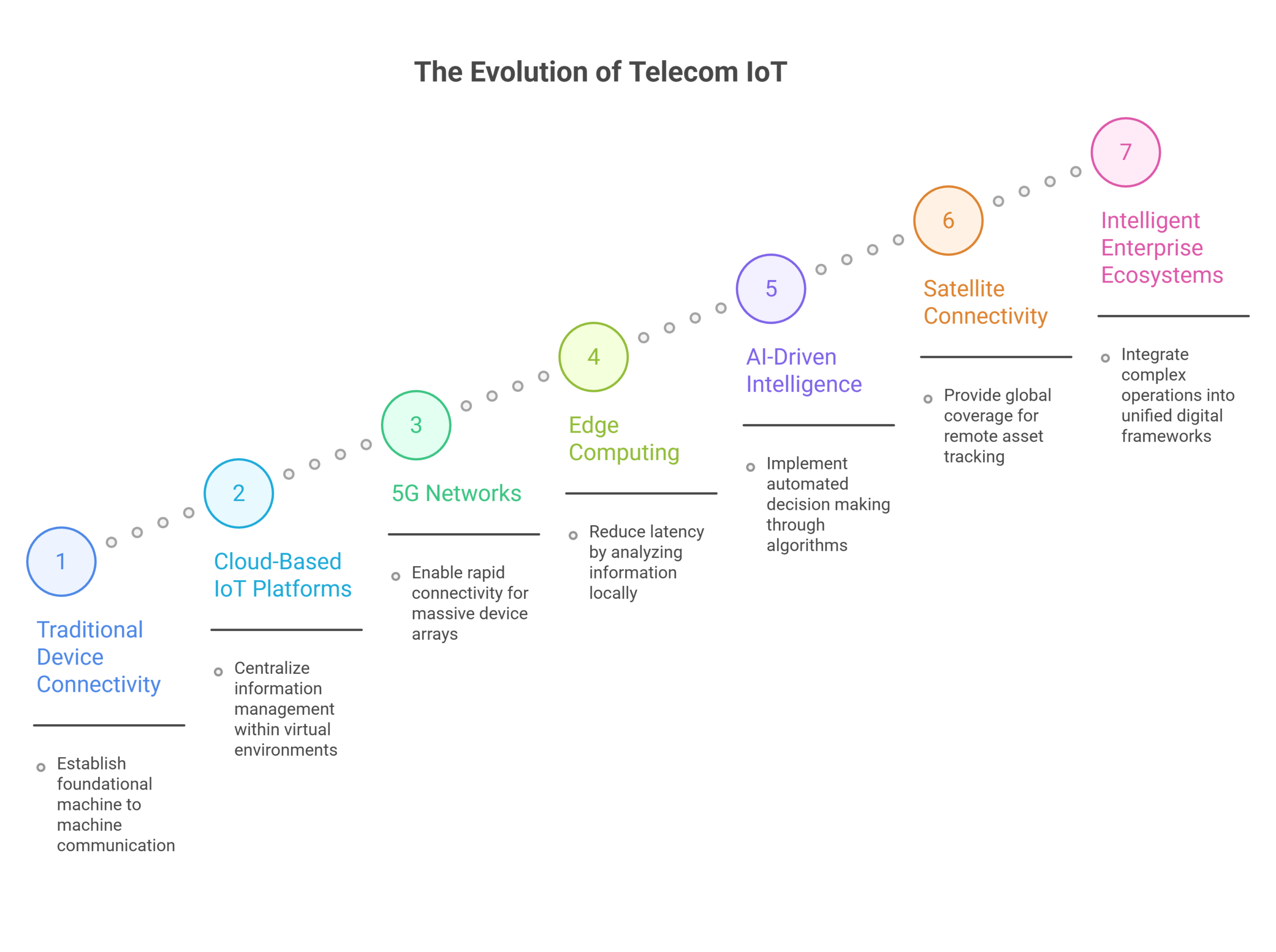
The early stages of IoT adoption focused largely on connecting devices through reliable cellular networks. While connectivity remains the foundation of every deployment, enterprise requirements have evolved considerably over the past decade. Modern organizations are no longer looking for networks that simply transmit data; they require intelligent platforms capable of managing connected assets, analysing information in real time, and supporting increasingly automated business processes.
This shift reflects the growing complexity of enterprise operations. Industrial equipment, environmental sensors, connected vehicles, healthcare devices, utility infrastructure, and countless other endpoints continuously generate operational data that must be monitored, analysed, and secured throughout their lifecycle. Managing this volume of information requires far more than traditional connectivity.
Modern Telecom IoT platforms are therefore evolving into comprehensive digital ecosystems that combine connectivity with cloud integration, device lifecycle management, advanced analytics, cybersecurity, and centralized network intelligence. Instead of operating as isolated communication services, these platforms provide enterprises with a unified environment for monitoring connected assets, maintaining service reliability, and improving operational visibility across geographically distributed networks.
The transition also reflects changing business priorities. Enterprises increasingly measure IoT investments by their ability to improve productivity, reduce operational costs, strengthen resilience, and support sustainability objectives. As a result, Telecom IoT is becoming an essential component of enterprise digital transformation rather than a standalone technology initiative.
5G and Edge Computing Are Building the Foundation for Intelligent Networks
The rollout of fifth-generation mobile networks has significantly expanded the capabilities of Telecom IoT by enabling faster, more reliable, and lower-latency communications. Unlike previous generations of wireless technology, 5G has been designed to support massive numbers of connected devices while maintaining the performance required for mission-critical enterprise applications. This makes it particularly well suited for industries where continuous connectivity and real-time decision-making are essential.
Equally important is the growing adoption of edge computing. Rather than sending every piece of information to centralized cloud platforms for processing, edge computing enables data to be analysed much closer to where it is generated. This distributed approach reduces latency, minimizes bandwidth consumption, and enables critical applications to respond almost instantly to changing operating conditions.
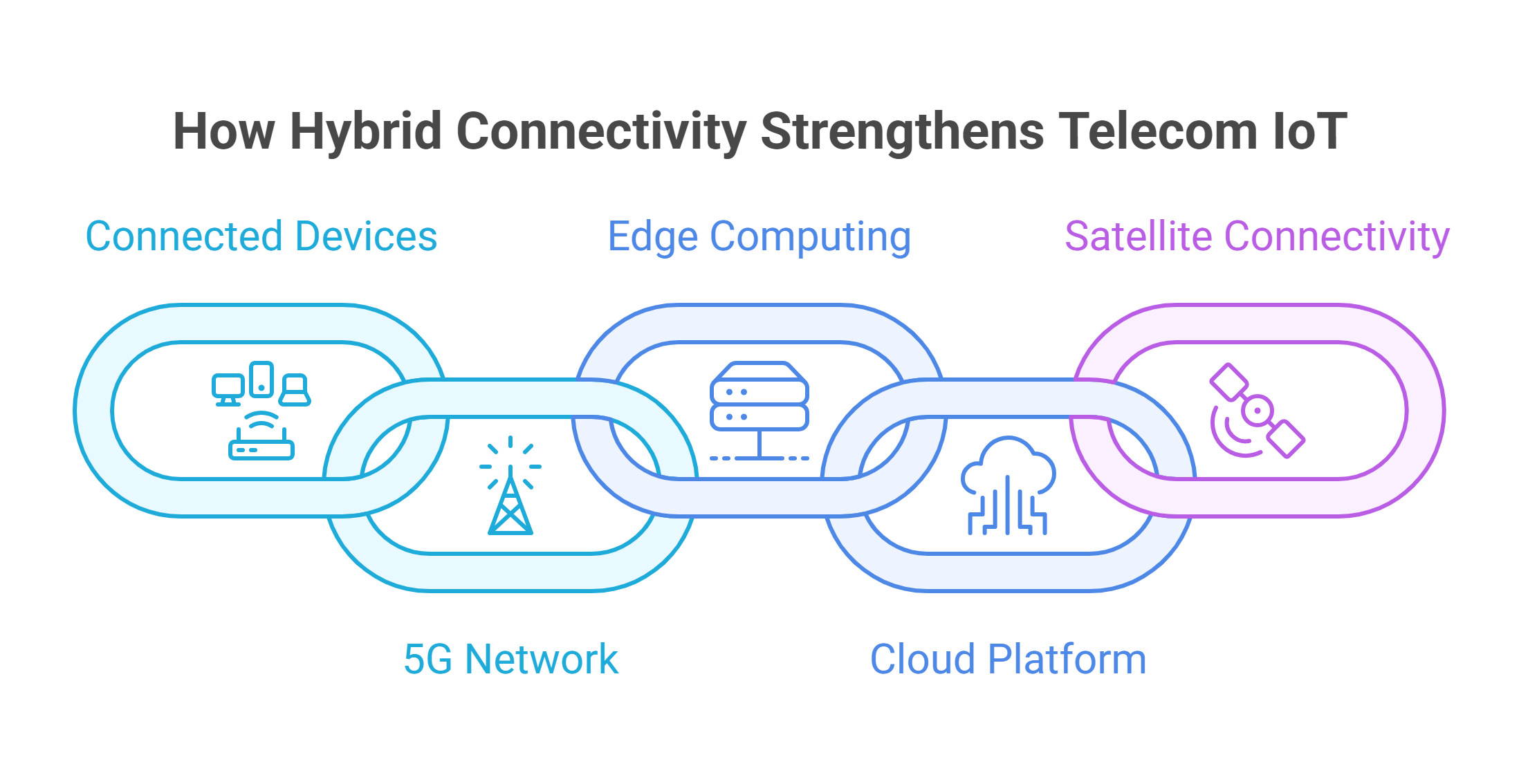
The combination of 5G and edge computing is transforming how organizations manage connected environments. Manufacturing facilities can monitor production equipment in real time, logistics companies gain greater visibility across supply chains, utilities can optimize distributed infrastructure more efficiently, and healthcare providers can support connected medical devices that depend on uninterrupted communications. By processing data closer to the source, enterprises can improve operational responsiveness while reducing the strain on centralized network resources.
As enterprise networks continue to expand, 5G and edge computing are becoming complementary technologies rather than separate innovations. Together, they provide the high-performance digital infrastructure needed to support increasingly sophisticated Telecom IoT deployments across a wide range of industries.
Artificial Intelligence Is Making Telecom IoT More Intelligent
As Telecom IoT ecosystems continue to expand, the volume of data generated by connected devices has reached unprecedented levels. Sensors, industrial equipment, connected vehicles, healthcare systems, and utility infrastructure continuously transmit operational information that traditional network management approaches can no longer process efficiently. Artificial intelligence (AI) is helping bridge this gap by transforming Telecom IoT data into actionable insights that support faster decision-making, predictive operations, and improved business outcomes.
Rather than serving as an additional technology layer, AI is becoming deeply integrated into Telecom IoT platforms to automate network operations and improve service performance. Machine learning algorithms can continuously analyse network behaviour, identify anomalies, predict equipment failures, and optimise resource allocation with minimal human intervention. By combining AI with Telecom IoT, enterprises are shifting from reactive maintenance strategies to predictive operations that reduce downtime while improving network reliability.
Artificial intelligence is also strengthening the security and scalability of Telecom IoT deployments. Intelligent systems can monitor millions of connected devices simultaneously, detect abnormal traffic patterns, identify potential cyber threats, and automate security responses before business operations are affected. As enterprise connectivity becomes increasingly data-intensive, AI is ensuring that Telecom IoT networks remain efficient, resilient, and capable of supporting next-generation digital services.
Satellite Connectivity Is Expanding the Reach of Telecom IoT
While terrestrial cellular infrastructure continues to support most connected devices, Telecom IoT increasingly requires reliable connectivity in remote and difficult-to-reach locations. Industries such as mining, agriculture, maritime transport, energy, and environmental monitoring often operate far beyond the coverage of conventional mobile networks. Satellite communications are therefore becoming an important extension of Telecom IoT, enabling uninterrupted connectivity across geographically dispersed operations.
Advances in low Earth orbit (LEO) satellites, geostationary satellite systems, and non-terrestrial networks (NTN) are significantly expanding the capabilities of Telecom IoT. Instead of replacing terrestrial infrastructure, satellite connectivity complements existing cellular networks by providing seamless communications whenever traditional coverage is unavailable. This hybrid networking approach ensures that connected devices continue transmitting operational data regardless of location.
As satellite technologies become more accessible, Telecom IoT is evolving into a truly global connectivity ecosystem. Hybrid terrestrial-satellite networks allow organizations to monitor assets, manage remote infrastructure, and maintain operational visibility across challenging environments without compromising service continuity. This extended coverage is expected to play an increasingly important role as enterprises continue expanding connected operations worldwide.
eSIM and Smart Connectivity Are Simplifying Telecom IoT Deployments
As Telecom IoT deployments continue to scale across multiple countries and industries, managing device connectivity has become increasingly complex. Traditional SIM cards often require physical replacement whenever connectivity requirements change, creating logistical and operational challenges for enterprises managing thousands of connected devices. eSIM technology is simplifying Telecom IoT by enabling remote provisioning and digital network management without requiring physical access to deployed assets.
The flexibility of eSIM technology allows Telecom IoT devices to switch network profiles remotely, reducing deployment times while improving operational agility. Organizations can activate, modify, or replace connectivity services digitally, making large-scale IoT deployments easier to manage throughout the device lifecycle. This capability is particularly valuable for globally distributed operations where uninterrupted connectivity is essential.
Smart connectivity platforms further enhance Telecom IoT by intelligently selecting the most suitable available network based on location, performance, and operational requirements. Instead of depending on a single communication network, enterprises can maintain continuous connectivity across multiple regions while simplifying device management, reducing operational costs, and improving overall network resilience.
Market Trends Reflect the Growing Strategic Value of Telecom IoT
The continued expansion of enterprise digital transformation is strengthening the long-term outlook for Telecom IoT. Organizations across manufacturing, transportation, healthcare, utilities, retail, and smart infrastructure are investing in connected technologies to improve operational efficiency, automate critical processes, and generate deeper insights from operational data. As a result, Telecom IoT is becoming a strategic business enabler rather than simply a communications solution.
Industry research indicates that Telecom IoT adoption will continue to grow alongside investments in 5G infrastructure, artificial intelligence, edge computing, and cloud-native platforms. Enterprises are increasingly building integrated digital ecosystems where connectivity, automation, and analytics work together to improve productivity and support long-term business transformation.
At the same time, the Telecom IoT market continues to face evolving commercial challenges. Pricing pressure, declining average revenue per connected device, and increasing competition are encouraging service providers to expand beyond connectivity by offering AI-powered analytics, cybersecurity services, intelligent network management, and integrated enterprise platforms. This shift reflects a broader industry trend where the value of Telecom IoT increasingly lies in delivering comprehensive digital solutions rather than connectivity alone.

Industry Considerations for the Next Phase of Telecom IoT
As Telecom IoT continues to mature, organizations must address several strategic considerations that will shape future adoption. Cybersecurity, interoperability, data governance, infrastructure investment, and regulatory compliance are becoming increasingly important as connected ecosystems expand across industries and geographical regions.
Ensuring interoperability between devices, communication standards, cloud environments, and network technologies remains essential for the continued growth of Telecom IoT. At the same time, organizations must strengthen cybersecurity frameworks capable of protecting millions of connected devices while maintaining service availability and safeguarding sensitive operational data.
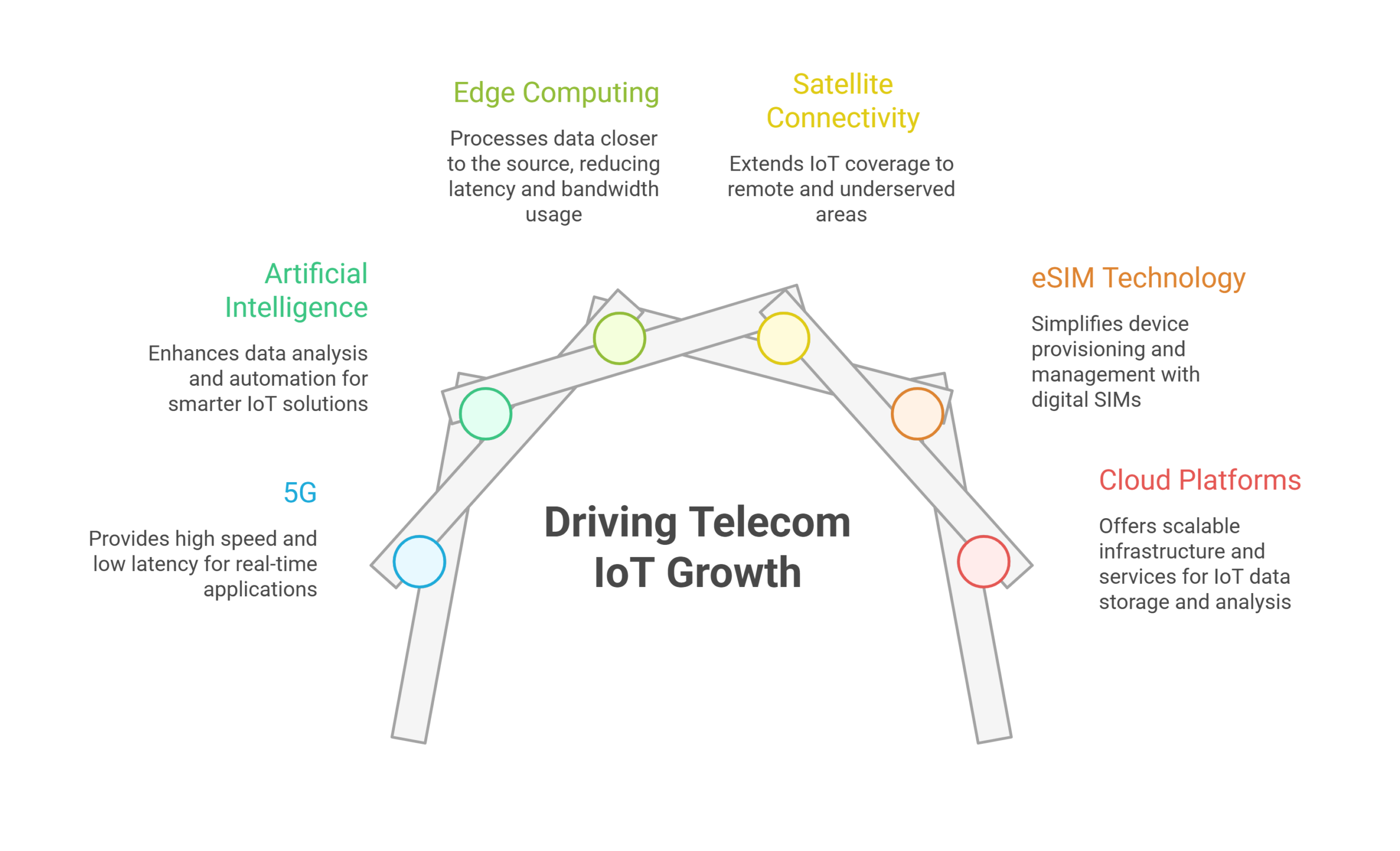
The future success of Telecom IoT will also depend on continued investment in digital infrastructure. Expanding 5G coverage, modernizing cloud-native networks, integrating edge computing, and extending satellite communications will all play important roles in supporting the next generation of intelligent enterprise connectivity. Rather than representing independent technology trends, these innovations are becoming interconnected components of a resilient Telecom IoT ecosystem designed to support long-term digital transformation.
Conclusion
Telecom IoT has evolved far beyond its original role of connecting devices. Today, Telecom IoT combines 5G, artificial intelligence, satellite communications, edge computing, and eSIM technology to create intelligent, secure, and scalable enterprise networks capable of supporting increasingly complex digital operations. This convergence is enabling organizations to improve operational efficiency, strengthen resilience, and make faster, data-driven decisions across connected environments.
Although challenges surrounding infrastructure, cybersecurity, interoperability, and investment remain, the continued advancement of Telecom IoT is reshaping enterprise connectivity across industries. As organizations accelerate digital transformation, Telecom IoT is expected to remain a foundational technology supporting the next generation of connected enterprises and intelligent network ecosystems.