




















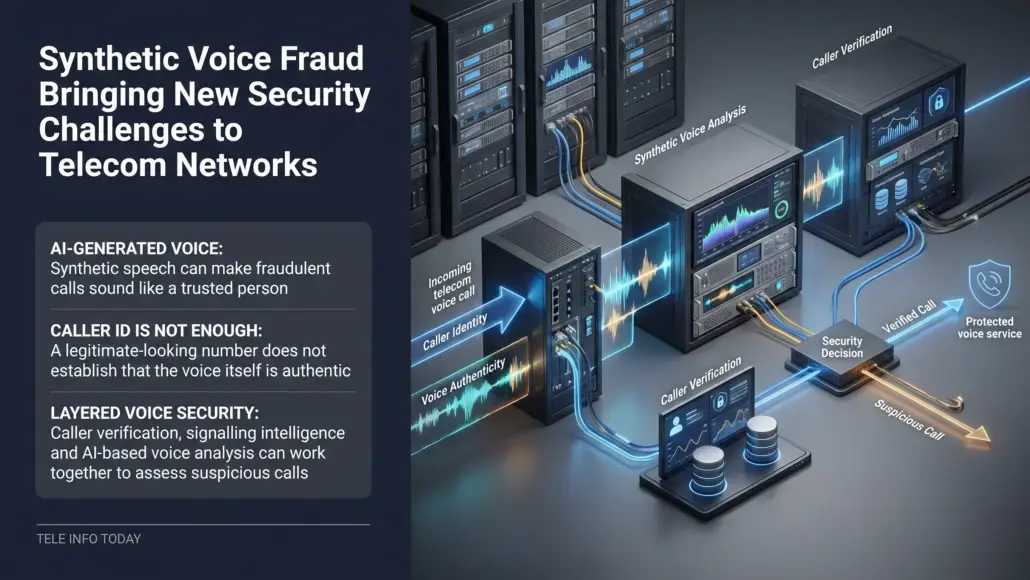

Voice communications are facing a new security challenge as artificial intelligence makes it easier to reproduce a person’s speech. Traditional voice scams have relied on caller-ID manipulation, impersonation and social engineering, but synthetic audio adds another layer by making a fraudulent call sound like it comes from a trusted person or organisation. Tele Info Today notes that synthetic voice telecom fraud is therefore becoming a telecom cybersecurity issue involving both caller identity and voice authenticity.
Voice Fraud is Moving from Spoofed Numbers Toward Synthetic Identities
Caller-ID spoofing can make a call appear familiar, while a synthetic voice can make the conversation itself more convincing. An attacker can combine these techniques with social engineering to create a compound attack that is harder to assess through conventional caller cues.
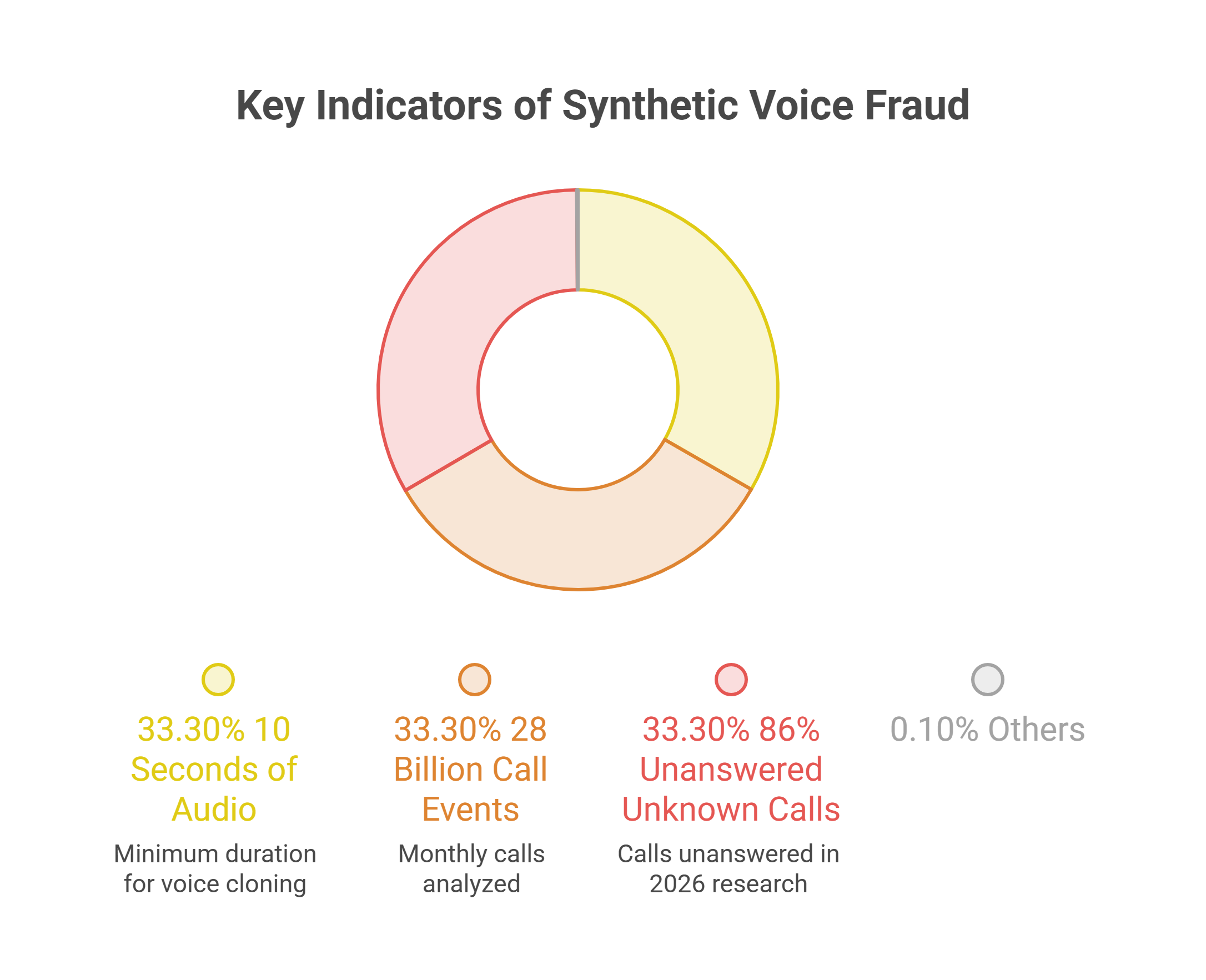
INTERPOL’s 2026 Global Financial Fraud Threat Assessment reports that convincing voice clones can be created from as little as 10 seconds of audio in some circumstances. The report also identifies AI-enabled fraud services offering synthetic identity capabilities.
The security challenge is therefore moving beyond whether a number appears trustworthy. synthetic voice telecom fraud can exploit the gap between verified caller information and the apparent authenticity of the speaker.
Caller Authentication Does Not Establish Voice Authenticity
Caller authentication and voice authenticity answer different security questions. Network controls can help establish whether a calling number has been legitimately presented, while voice analysis can assess whether audio has characteristics associated with synthetic generation or manipulation.
A legitimate number can therefore still be used with a convincing cloned voice to persuade a recipient to disclose information or authorise an action. As telecom security expands across network infrastructure and identity controls, caller identity controls, voice security is becoming another layer in the wider security lifecycle.
synthetic voice telecom fraud consequently creates a need for multiple independent signals rather than relying on a telephone number or voice impression alone.
Key Takeaway: Synthetic voice is making impersonation more convincing, increasing the need for layered caller authentication and network-level voice security.
Voice Security is Moving Toward Layered AI and Caller Verification
The emergence of synthetic audio is pushing telecom security beyond traditional caller screening. A network can establish information about a calling number, but that does not necessarily establish whether the voice itself is authentic. This is making synthetic voice telecom fraud increasingly dependent on multiple security signals, including caller identity, signalling information, call behaviour and AI-based audio analysis.
AI Detection is Moving into the Voice Network
Traditional approaches to unwanted calls have relied on reputation databases, known-number lists and traffic patterns. Synthetic voice creates a more adaptive threat because the audio can be generated or modified for each interaction. Detection systems therefore need to identify suspicious combinations of network and behavioural signals rather than relying on a single indicator.
GSMA’s 2026 case study on network-level voice protection describes AI-based systems analysing billions of call events and adapting to changing scam patterns. Hiya’s current voice-security network analyses approximately 28 billion calls per month across more than 40 countries, illustrating the scale at which automated call-risk analysis is increasingly being performed.
For synthetic voice telecom fraud, this creates a shift from static blocking toward continuous analysis. A suspicious call can potentially be assessed using the calling number, network characteristics, calling behaviour and other available signals before the recipient decides whether to trust the interaction.
Caller Verification is Adding Another Security Layer
AI-based audio detection is not the only response. Telecom and industry initiatives are also working on stronger ways to establish who is authorised to make a call.
Open Verifiable Calling, for example, is designed around cryptographically verifiable caller identity, allowing organisations to demonstrate that a number is associated with an authorised entity before the call reaches the recipient. This approach addresses a different part of the problem from synthetic-voice detection: rather than asking only whether the audio sounds genuine, it establishes whether the caller has a verifiable identity.
These approaches can therefore complement each other, Caller Verification, Who is making the call?, Voice Analysis, Does the audio show signs of manipulation and Network Intelligence, What additional context surrounds the call?
Together, these layers can provide more information for security decisions than any single control.
Synthetic Voice is Increasing Pressure on Detection Systems
Voice-security models also face a moving target. New synthesis techniques can produce different acoustic characteristics, while compression, background noise and network conditions can alter genuine and synthetic audio. Recent research on voice-authentication threats notes that anti-spoofing systems can struggle with previously unseen attack techniques, reinforcing the need for continuous evaluation and adaptation.
This makes synthetic voice telecom fraud a wider network-security problem rather than a problem that can be solved only through an audio classifier. Detection, caller verification and network-level intelligence increasingly need to operate together.
Voice Security is Becoming a Network Responsibility
Telecom voice security is increasingly moving beyond caller-ID protection toward a layered model that combines identity verification, signalling intelligence and analysis of the voice itself. Synthetic voice telecom fraud highlights the limits of relying on any single indicator, particularly when attackers can combine legitimate-looking numbers with AI-generated speech and social engineering.
Protecting voice services therefore requires cooperation between network operators, technology providers and the organisations receiving calls. Cryptographically verifiable caller identity, network-level monitoring and adaptive detection can provide complementary signals while maintaining appropriate controls over sensitive communications data.
Tele Info Today notes that the broader challenge is restoring trust in voice communications as synthetic audio becomes more accessible. As telecom networks strengthen caller verification and real-time detection, voice security is becoming an increasingly integrated part of the wider cybersecurity architecture supporting digital communications.