



















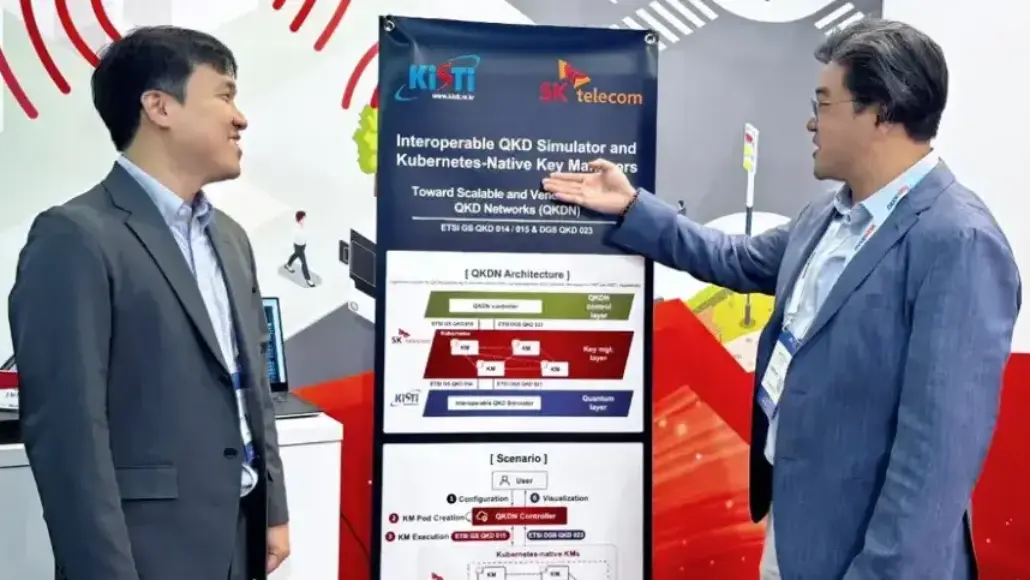

SK Telecom and the Korea Institute of Science and Technology Information (KISTI) have developed a digital twin-based technology to test the performance and operational feasibility of quantum cryptographic communication networks before physical deployment. The system links SK Telecom’s quantum key management system with KISTI’s quantum key distribution (QKD) simulator through an international standards-compatible interface, creating a virtual environment for quantum network testing.
The technology was unveiled at the European Conference on Optical Communication (ECOC) 2026 in Malaga, Spain. It addresses a practical challenge in quantum cryptography: testing physical network conditions can be difficult because deployed equipment is expensive and parameters such as optical cable length and signal loss are not easily changed once infrastructure is installed.
Digital Twin Replicates Quantum Network Conditions
Under the new system, SK Telecom’s Key Manager can request quantum keys from KISTI’s QKD simulator, which can reproduce different communication environments and provide generated keys together with performance and status information in real time. This creates a virtual setting in which the process from quantum key generation through management and delivery can be tested.
The digital twin can also reflect network conditions such as communication distance and optical loss, as well as equipment characteristics including reception efficiency and post-processing algorithms. This allows quantum network testing to examine how different configurations could perform before the corresponding hardware is installed in a physical environment.
SK Telecom’s key management system is built using containers and operated through Kubernetes, allowing it to be deployed flexibly across different environments. KISTI’s simulator can reproduce a range of QKD conditions, while a network control system links the simulator and key management system to coordinate the virtual test environment.
Standards-Based Interoperability Supports Expansion
A key element of the development is the use of an interface compatible with standards established by the European Telecommunications Standards Institute (ETSI). The approach is intended to reduce dependence on proprietary interfaces and allow quantum cryptography equipment developed by other organizations or companies to work with the system in the future.
The organizations said the technology represents the first public verification of a quantum key management system and a QKD simulator independently developed by different institutions being linked together. The combination provides a platform for quantum network testing across different network conditions and key management scenarios while supporting interoperability between systems.
The development was carried out through projects backed by South Korea’s Ministry of Science and ICT focused on improving QKD network efficiency, resource optimization and quantum cryptographic network technology. The system was demonstrated at the SK Broadband booth at ECOC 2026.
The technology remains a testing and validation platform rather than a commercial quantum cryptographic network deployment. However, the ability to conduct quantum network testing in a virtual environment could help network developers evaluate configurations, equipment placement and operating conditions before building physical infrastructure, while standards-based interfaces provide a path for broader interoperability.