




















Fibre networks are increasingly being considered for functions beyond the transmission of data as optical sensing creates opportunities to use deployed infrastructure to detect changes in the surrounding environment. Distributed fibre optic sensing can identify acoustic, vibration, temperature and strain changes along the length of an optical fibre, allowing a single route to provide information across extensive physical areas. This expands the role of fibre from a communications medium toward a distributed measurement platform, particularly where operators already have fibre infrastructure covering locations that are difficult or expensive to monitor with separate sensors.
The development is moving beyond research concepts into formal technical frameworks and field demonstrations. ITU T G.681, approved in November 2025, establishes interface requirements for integrating distributed fibre optic sensing with terrestrial optical transmission systems and allows the sensing fibre to also carry communications traffic. This is significant because it addresses one of the main practical questions surrounding optical sensing: whether monitoring capabilities can be introduced while communications services continue to operate over the same physical infrastructure.
Research and operator activity also spans multiple regions and applications. In Japan, NTT and NEC have demonstrated traffic monitoring using existing communications fibre, while Orange has presented fibre detection technology combining distributed acoustic sensing with event classification. Research involving deployed telecom cables is also examining applications including road monitoring, intrusion detection and cable protection. These developments indicate that optical sensing is moving toward a broader infrastructure role in which existing fibre routes can generate information about physical activity around them.
Integrated Sensing and Communications Advancing Fibre Use Cases
The technical progress is also being demonstrated alongside high-capacity communications. At OFC 2026, researchers demonstrated distributed acoustic sensing over a 40-channel 800 Gb/s DWDM network, showing that sensing signals can coexist with communications traffic in an appropriately designed optical system. Such developments are important because they could reduce the need for separate physical sensing infrastructure in some applications while extending the value of already deployed fibre.
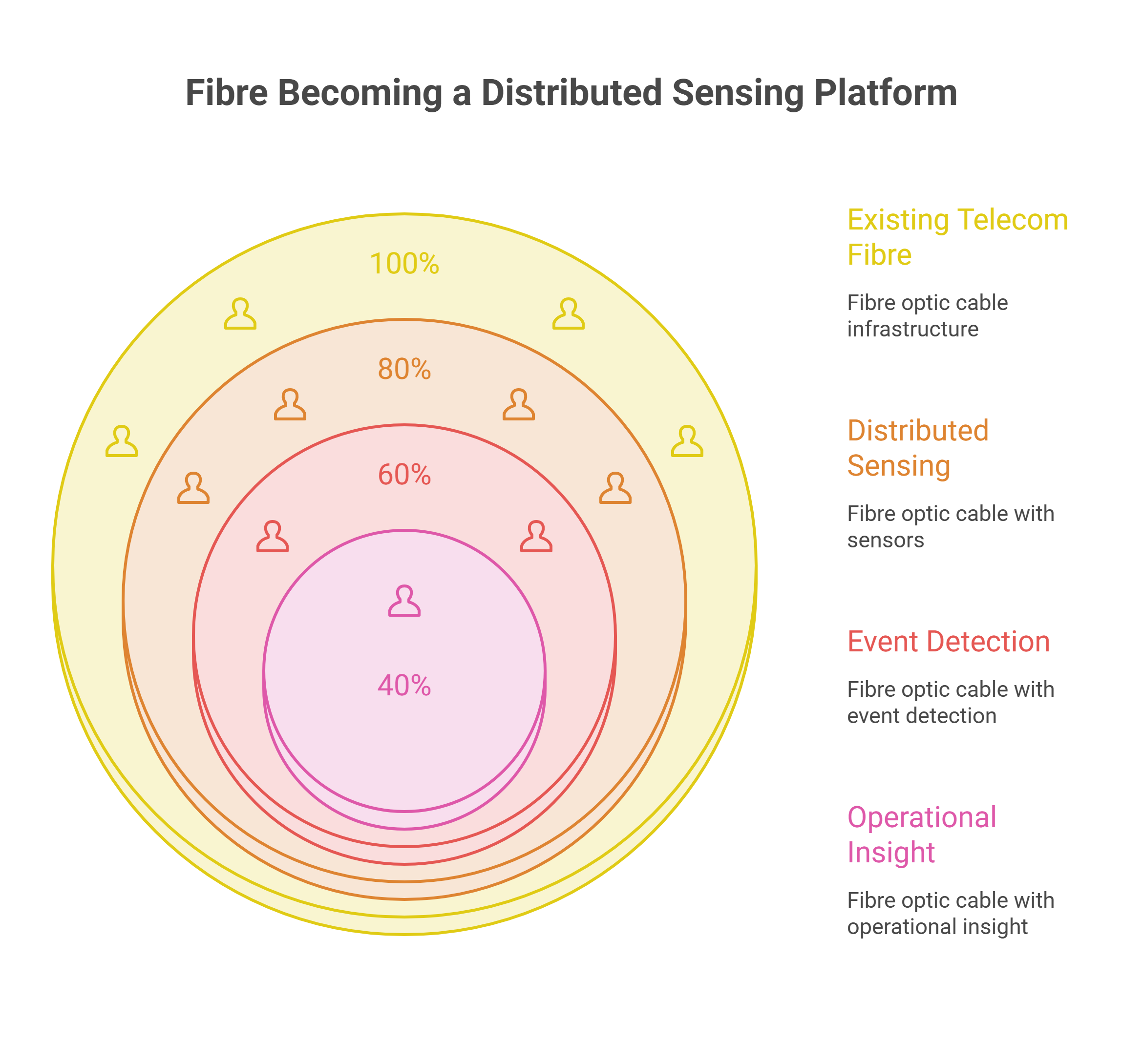
Fibre infrastructure can increasingly support sensing alongside communications, creating additional monitoring capabilities without requiring a separate physical sensor network in every application.
Fibre Sensing Moving into Operational Monitoring
The practical value of optical sensing increasingly depends on how sensing systems can work with fibre already carrying communications traffic. The ITU T G.681 Recommendation provides a framework for integrating distributed fibre optic sensing with terrestrial optical transmission systems, covering issues such as wavelength allocation, interference and allowable crosstalk between sensing and communications channels. This creates a technical basis for deploying sensing capabilities without treating the communications network and sensing system as completely separate infrastructures.
Research is also examining different sensing architectures according to the characteristics of existing telecom networks. A 2026 Journal of Optical Communications and Networking study involving Verizon and NEC Laboratories America examined backscattering, forward transmission and hybrid approaches for using deployed telecom cables as sensing media. The work identifies applications including road traffic monitoring, pavement assessment, intrusion detection and cable damage prevention, while also noting that some backscattering approaches can face limitations in amplified DWDM environments. These distinctions are important because the suitability of optical sensing depends not only on the sensing application, but also on the architecture and operating conditions of the underlying fibre route.
AI Turning Fibre Measurements into Operational Signals
Another development is the move from collecting physical signals to interpreting them in real time. NEC has demonstrated the use of existing communications fibre for continuous road monitoring and reported an approximately 80% reduction in travel-time prediction error in a traffic congestion application compared with a conventional point-sensor approach. The company has also explored applications involving infrastructure intrusion, bridge deterioration and fibre damage detection.
Commercial activity is extending this model into other infrastructure applications. Orange’s Fiber Detection pilot uses existing access fibre, distributed acoustic sensing and AI-based analysis to identify events such as water leaks near fibre infrastructure. In March 2026, VIAVI also introduced a distributed acoustic sensing interrogator with embedded AI and machine learning for real-time event detection, localisation and classification at the network edge. Such developments suggest that optical sensing is evolving from a measurement technology into a monitoring layer where fibre-generated signals can be analysed and converted into information relevant to network maintenance, infrastructure protection and other operational processes.