




















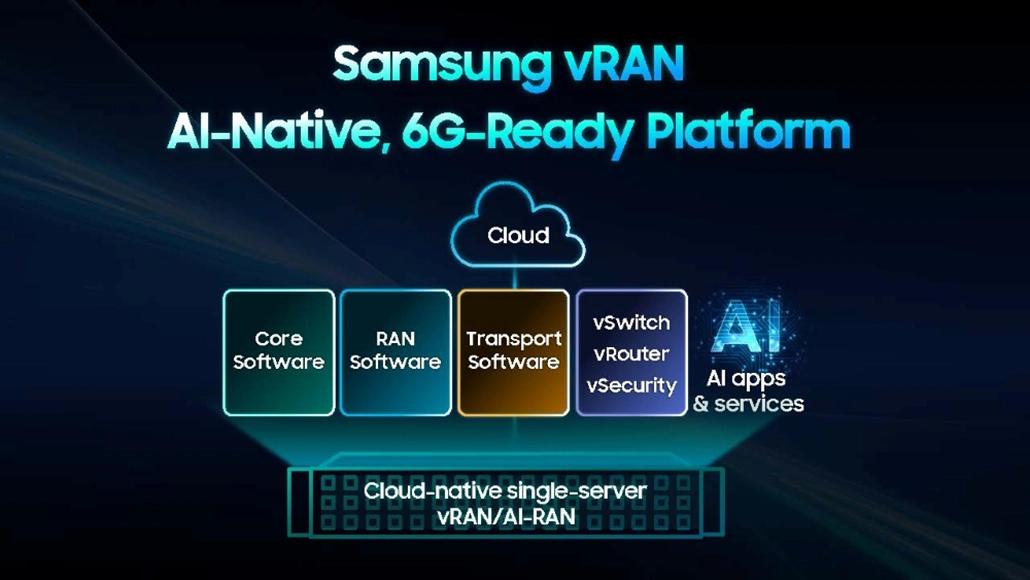

Samsung Electronics and Intel have demonstrated that single-server vRAN can operate reliably on a live commercial network, marking a key step toward reducing hardware complexity and lowering total cost of ownership for telecom operators.
The partners successfully completed a commercial call over a Tier 1 US operator’s live network using Samsung’s virtualised RAN software platform running on Intel’s Xeon 6700P-B processor series. The deployed system ran on a commercial off-the-shelf (COTS) server from Hewlett Packard Enterprise (HPE) and used a cloud platform from Wind River.
The demonstration highlighted how compute-intensive network functions, which in the past required dedicated hardware, can now be virtualised and consolidated on a single server. By running RAN and AI workloads together on Intel Xeon 6 processors with up to 72 cores, Samsung’s RAN virtualisation solution enables operators to meet the performance demands of the mobile edge without impacting either function.
The server consolidation also creates a path for operators to significantly reduce CAPEX and OPEX by reducing server count, as well as minimising power consumption and simplifying site operations. The solution also contributes to the network sustainability efforts of operators as they modernise their networks from proprietary hardware to software-defined infrastructure.
The live deployment builds on Samsung’s earlier 2024 lab testing and confirms the readiness of single-server vRAN under real-world traffic conditions.
“This breakthrough represents a major leap forward in network virtualisation and efficiency. It confirms the real-world readiness of this latest technology under live network conditions, demonstrating that single-server vRAN deployments can meet the stringent performance and reliability standards required by leading carriers,” said June Moon, Executive VP and Head of R&D, Networks Business at Samsung Electronics.
The system used Intel Xeon 6 system-on-chip technology with Intel Advanced Matrix Extensions and Intel vRAN Boost, enabling higher AI processing performance and improved memory bandwidth compared with earlier platforms.
“This collaborative achievement with Samsung, HPE and Wind River enables greater consolidation of RAN and AI workloads, lowering power and total cost while speeding innovation,” said Cristina Rodriguez, VP and GM, Network & Edge at Intel.
Industry analysts view the milestone as evidence that virtualised and open network architectures are moving from theory to deployable reality. While broader rollouts will still require careful integration and resilience planning, the demonstration shows that operators can now support cloud-native, AI-ready networks with fewer physical servers.