


















Key Takeaways for AI-Enhanced Connectivity
- The first vital takeaway is that AI is the primary catalyst for achieving “autonomous networking.” We are moving toward a state where the network functions much like a self-driving car, making thousands of micro-adjustments every second to ensure safety and efficiency. This autonomy is critical for the success of 5G and 6G, where the sheer number of nodes and the speed of the signals make manual management physically impossible. AI-driven systems are the only way to manage the massive scale of future digital infrastructure.
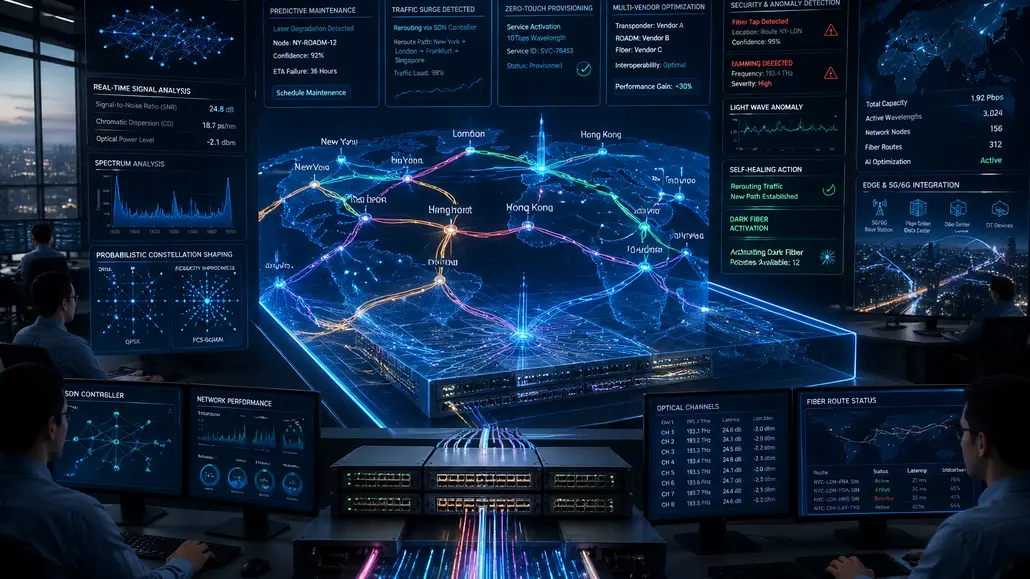
- The second key point is the role of AI in security. As networks become more integrated into critical infrastructure, they also become more attractive targets for cyberattacks. AI optical networks can detect the physical signatures of an unauthorized tap or a sophisticated jamming attempt by monitoring the behavior of light waves within the fiber. By identifying these anomalies in real-time, the network can automatically reroute sensitive data or trigger an alarm, providing a layer of security that exists at the physical, rather than just the logical, level.
The global telecommunications landscape is undergoing a period of exponential complexity. As we layer 5G services, edge computing, and massive IoT deployments onto existing fiber backbones, the number of variables required to maintain a high-performance network has surpassed the capacity of human operators to manage manually. This challenge has ushered in the era of AI optical networks—systems that leverage machine learning and deep analytics to self-optimize, self-heal, and self-configure. By embedding intelligence directly into the optical layer, the industry is moving toward a future where “smart connectivity” is not just a marketing term, but a functional reality that maximizes data performance across every kilometer of glass.
The Shift Toward Cognitive Optical Networking
For most of their history, optical networks were “dumb” pipes static connections that were provisioned once and rarely changed unless a physical fault occurred. In contrast, AI optical networks are “cognitive.” They possess a sense of awareness regarding their own internal state and the external environment. This awareness is fueled by telemetry data—a constant stream of information regarding signal-to-noise ratios, power levels, and chromatic dispersion. Artificial intelligence algorithms analyze this data in real-time, identifying patterns that are invisible to the human eye.
This shift toward cognitive networking allows for dynamic resource allocation. Instead of leaving massive amounts of “dark fiber” or unused bandwidth as a buffer for peak times, an AI-driven system can adjust capacity on the fly. If a sudden surge in traffic is detected in a specific region, the network can automatically reconfigure optical paths and adjust modulation formats to accommodate the load. This fluidity is essential for maintaining high data performance in a world where traffic patterns are increasingly volatile and unpredictable.
Harnessing Predictive Analytics for Uninterrupted Service
One of the most valuable applications of AI in telecom is predictive maintenance. In a traditional network, a fiber break or a failing laser is only addressed after the service has been disrupted. With predictive analytics, AI can identify the subtle signs of a failing component weeks before it actually breaks. For example, a gradual increase in error rates or a slight fluctuation in laser temperature can be flagged by a machine learning model as a precursor to failure. This allows technicians to replace the component during a scheduled maintenance window, preventing a costly and disruptive emergency outage.
Furthermore, AI optical networks can predict traffic trends with remarkable accuracy. By analyzing historical data and correlating it with external factors like major public events or local holidays, the system can “pre-load” capacity where it will be needed most. This proactive approach to network management ensures that users never experience the slowdowns typically associated with peak usage hours. By staying one step ahead of demand, AI-driven systems provide a level of reliability and consistency that is foundational to modern digital life.
Intelligent Network Automation and SDN Integration
The true power of AI is realized when it is combined with Software-Defined Networking (SDN). While the AI provides the “brain,” SDN provides the “muscle” to execute changes across the infrastructure. Network automation allows for the “zero-touch” provisioning of services. When a new customer requests a high-speed link, the AI can analyze the current network topology, identify the most efficient route, and instruct the SDN controller to configure the necessary optical switches and transceivers without any manual intervention.
This level of automation drastically reduces the time-to-service, turning a process that used to take weeks into one that takes minutes. Moreover, it eliminates the risk of human error one of the leading causes of network downtime. As networks grow in scale and complexity, the ability to automate repetitive tasks is not just a matter of efficiency; it is a matter of survivability. By freeing human engineers from the minutiae of configuration, AI optical networks allow them to focus on high-level strategy and innovation, further accelerating the pace of technological progress.
Optimizing Bandwidth Management and Data Performance
In the relentless pursuit of better data performance, AI is helping to squeeze every possible bit of capacity out of existing fiber strands. “Probabilistic constellation shaping” is a technique where AI optimizes how data is mapped onto optical signals based on the specific characteristics of a given fiber link. By tailoring the transmission to the unique “fingerprint” of the cable, AI can increase capacity by up to 30% without changing the physical hardware. This is a game-changer for service providers looking to maximize their return on investment in legacy fiber plants.
Additionally, AI optical networks are instrumental in managing “multi-vendor” environments. In the past, network management systems were often proprietary, making it difficult to integrate equipment from different manufacturers. AI-driven platforms can act as a universal translator, normalizing data from various sources and providing a unified view of the entire network. This interoperability fosters a more competitive and innovative marketplace, as providers are no longer “locked in” to a single hardware vendor.
Conclusion: The Intelligent Horizon of Optical Networking
The integration of artificial intelligence into the world of optical communication marks the beginning of a new chapter in human connectivity. AI optical networks are no longer a theoretical research project; they are the standard for high-performance telecom infrastructure in the 21st century. By combining the raw speed of light with the analytical power of machine learning, we are creating a digital nervous system that is more resilient, more efficient, and more capable than anything that has come before.
As we look to the future, the synergy between AI and optics will only deepen. We can expect to see AI algorithms running directly on the optical chips themselves, providing even lower latency and higher levels of autonomy. The journey toward smart connectivity is a journey toward a world where information flows as freely and naturally as the light that carries it. In this future, the network is not just a utility, but an intelligent partner that adapts to our needs, protects our data, and powers the innovations of the next generation.